

48 Entryway Bench Ideas: Storage, Style & Small Hallway Solutions
Why the entryway bench does more than hold coats
The entryway is the first thing you see when you come home and the last thing you see when you leave. A bench is the one piece of furniture that works in both directions.
It gives you somewhere to sit while you pull off wet boots. It gives coats and bags a place that is not the back of a chair.
It also sets the tone for the whole house. A well-chosen bench tells you what kind of home this is before you have taken three steps inside.
Most hallway problems come down to the same three things. Not enough storage, not enough light, and nowhere to put your hands.
A bench fixes all three at once. The seat takes the bags, the space underneath takes the shoes, and the wall above takes the coats.
This guide covers 48 different ways to do it. Every idea has a photo, a materials note and the reason it works.
Read straight through, or jump to the section that matches your hallway. Then steal the one that fits.
Jump to a section
- How to pick the right bench
- Natural wood and minimal benches (Ideas 1 – 8)
- Built-in, mudroom and storage benches (Ideas 9 – 16)
- Upholstered and soft benches (Ideas 17 – 24)
- Small space and narrow hallway benches (Ideas 25 – 32)
- Farmhouse, vintage and coastal benches (Ideas 33 – 40)
- Modern, luxury and statement benches (Ideas 41 – 48)
- Five styling rules
- Entryway bench FAQ
How to pick the right bench for your hallway
Start with depth, because depth decides everything else. A bench should be 35cm to 45cm deep for comfortable sitting.
If your hallway is under 110cm wide, go wall-mounted and stay at 25cm or less. You can still perch on it, and the floor stays walkable.
Next, measure your longest coat. Hooks need 150cm of clear height above the bench seat so long coats do not pool on it.
Then think about shoes. Count the pairs that actually live by the door, not the pairs you wish lived by the door.
Ten pairs need roughly one 60cm-wide bay with two shelves. Twenty pairs need drawers or a full shoe cabinet.
Finally, decide who sits on it. Adults need 45cm seat height. Children and anyone with limited mobility are happier at 48cm.
Match the finish to the traffic. Matt lacquer and wax hide scuffs, high gloss does not, and pale velvet will not survive a school run.
Ideas 1 – 8Natural wood and minimal benches
Wood is the safest place to start, and the hardest to get wrong. These eight designs lean on grain, proportion and clean edges instead of ornament.
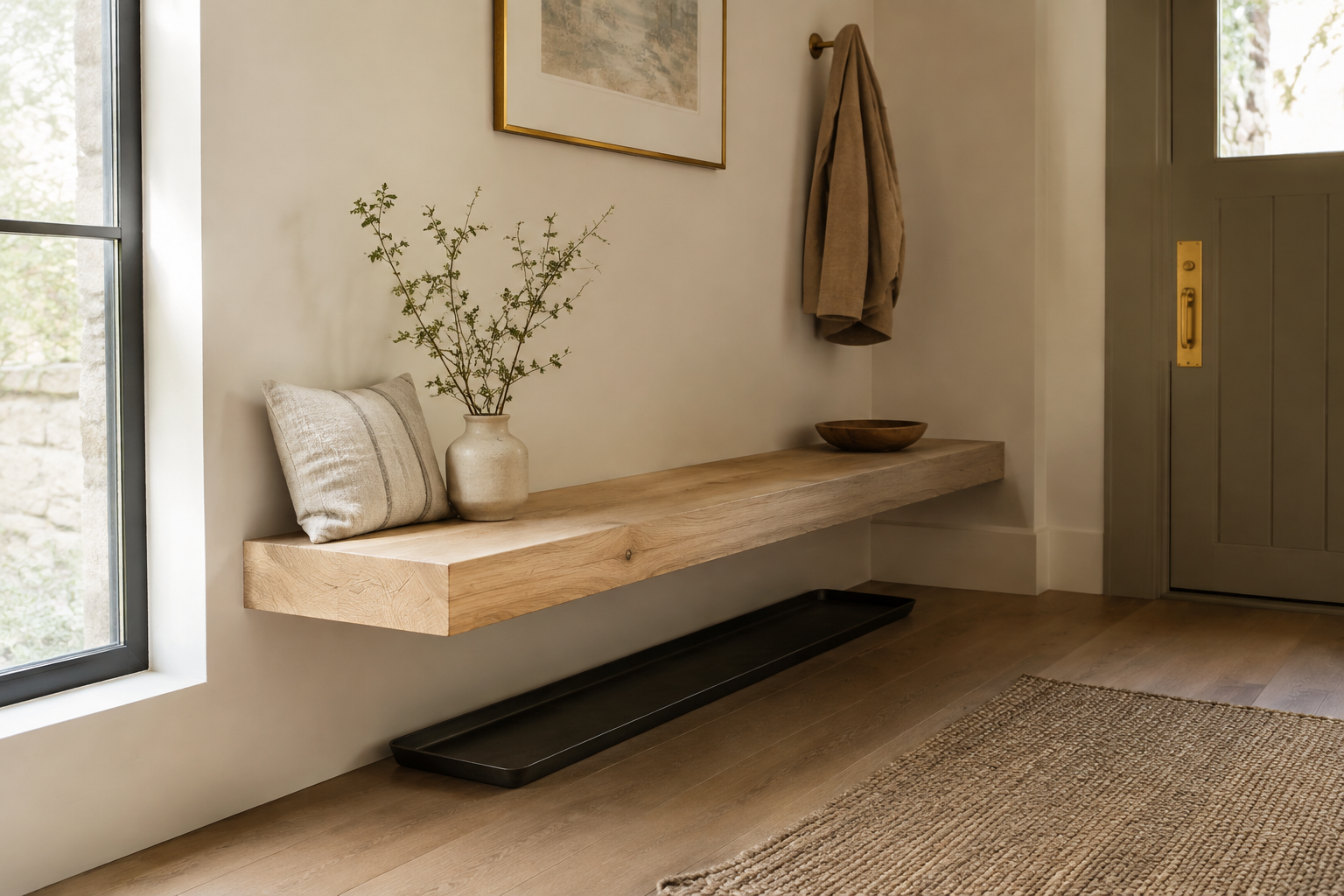
Idea 01
The floating oak slab
This bench is one thick slab of white oak fixed straight to the wall. Hidden steel brackets leave the floor completely clear, so the hallway reads wider than it is.
Keep the slab at 45mm thick and around 1.5m long for balance. A soap finish keeps the grain pale and matte instead of glossy.
A slim boot tray underneath is the only thing allowed below it. Empty floor is the whole point of the design.
Thick white oak slab entryway bench floating on the wall with a boot tray underneath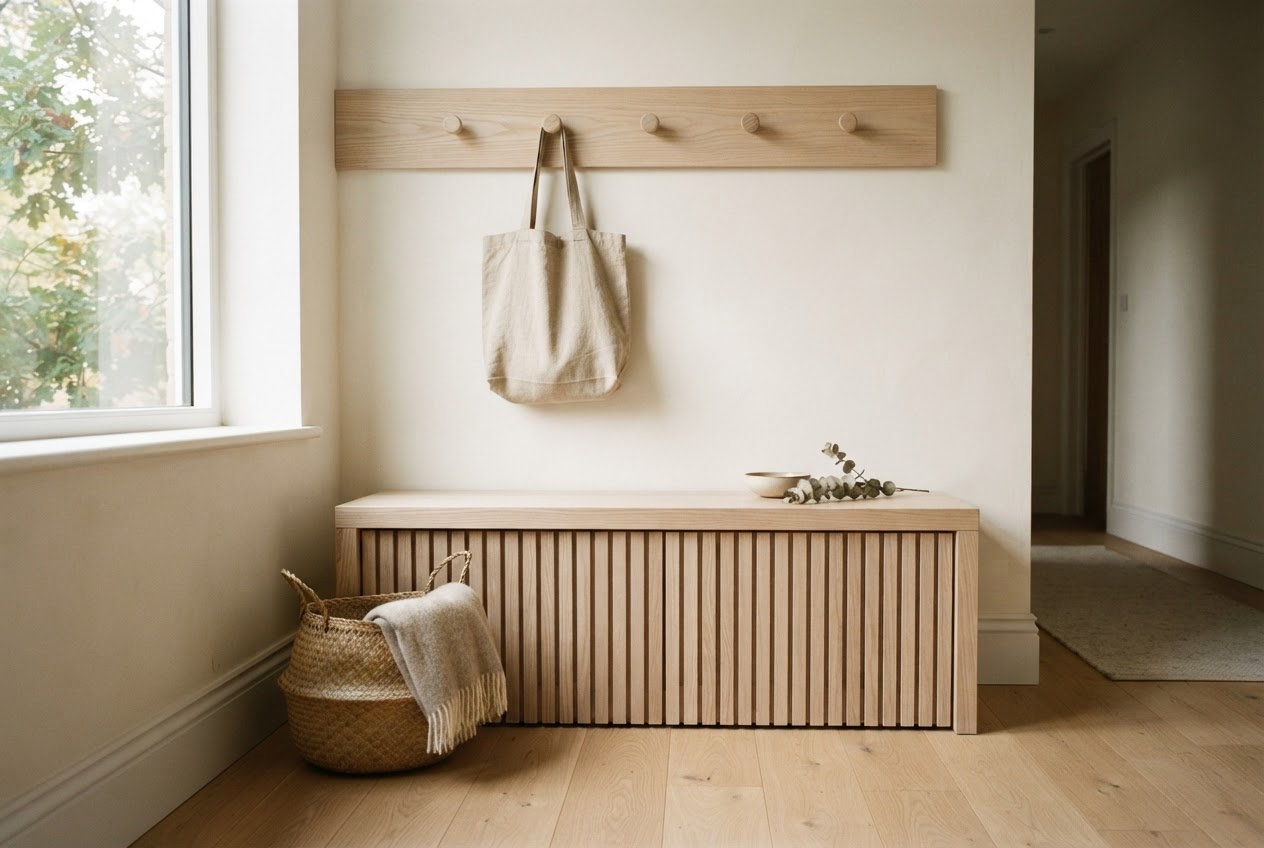
Idea 02
Light ash slat bench with a peg rail
Thin vertical ash slats form both the seat front and the wall panel. The gaps let the wall colour show through, which stops a narrow hall feeling boxed in.
A row of round wooden pegs sits above at shoulder height. Bags and coats hang clear of the seat, so the bench always stays usable.
Space the pegs 20cm apart and stagger none of them. Even spacing reads calm from the front door.
Pale ash slatted entryway bench with a round wooden peg rail above it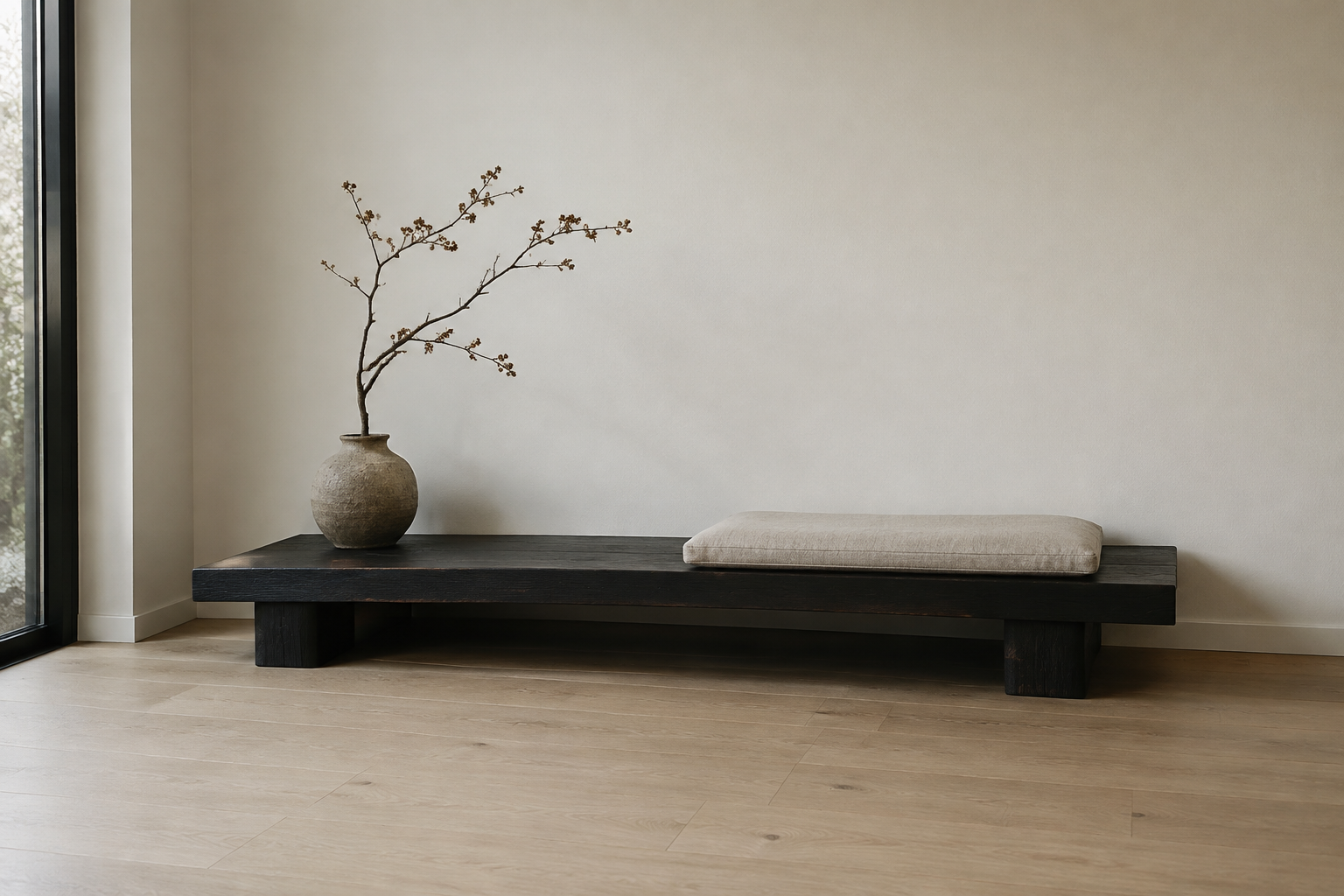
Idea 03
Japandi low platform bench
Japandi is about restraint, so this bench sits only 35cm high on a blackened ash frame. One flat linen cushion softens the top without adding visual weight.
Place a single ceramic vase at one end. Two objects read as intentional and five read as clutter.
Keep the wall behind it completely bare. Negative space is what makes the low profile look deliberate.
Low blackened ash Japandi bench with a flat linen cushion in a calm white hallway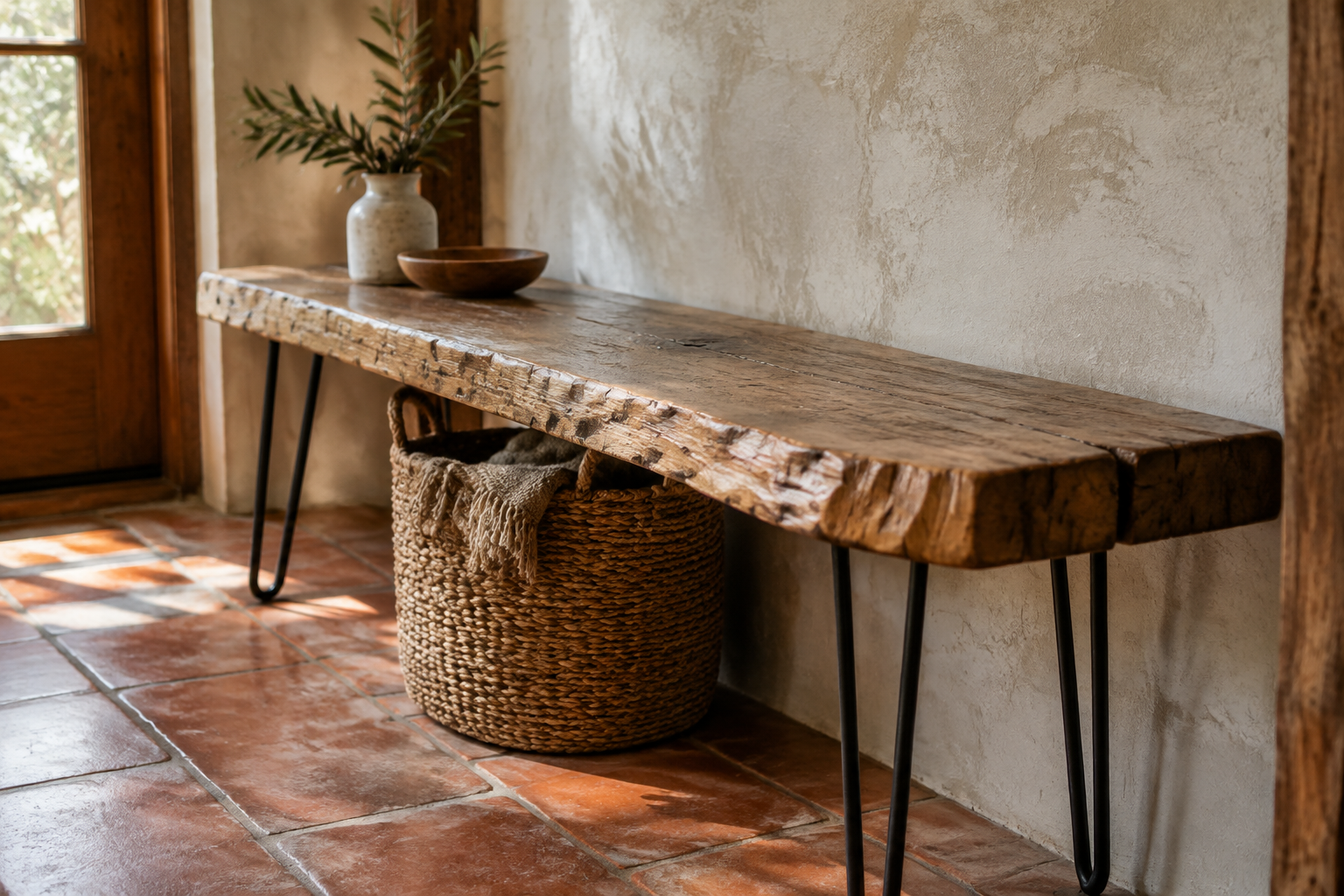
Idea 04
Reclaimed beam with a live edge
A century-old barn beam becomes the seat, with the original saw marks left in place. Live edges and iron hairpin legs give the entryway instant history.
Seal it with hard wax oil rather than polyurethane. Old timber should feel dry and honest, not plastic.
Add a woven basket underneath and stop there. One found object is enough against a surface this strong.
Live edge reclaimed timber beam bench on iron hairpin legs in a rustic entryway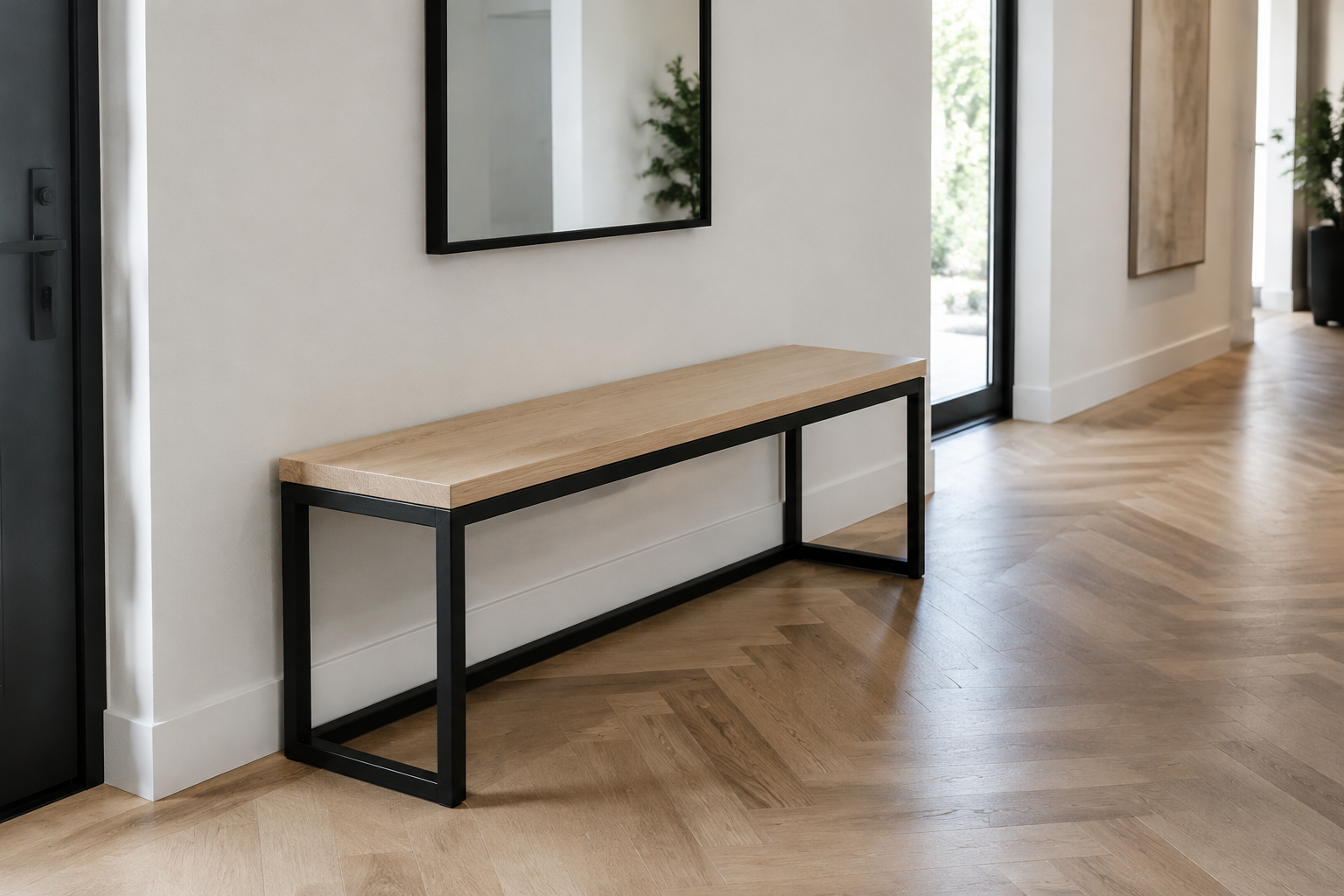
Idea 05
Pale oak on blackened steel
A pale oak top on a matte black steel frame is the easiest modern pairing to get right. The contrast gives structure without heaviness.
Choose square tube legs rather than round. Straight lines echo the hallway walls and sharpen the whole arrangement.
Repeat the black once more in the room, in a mirror frame or a hook rail. One repeated note ties the corner together.
Pale oak top entryway bench with a matte black square steel frame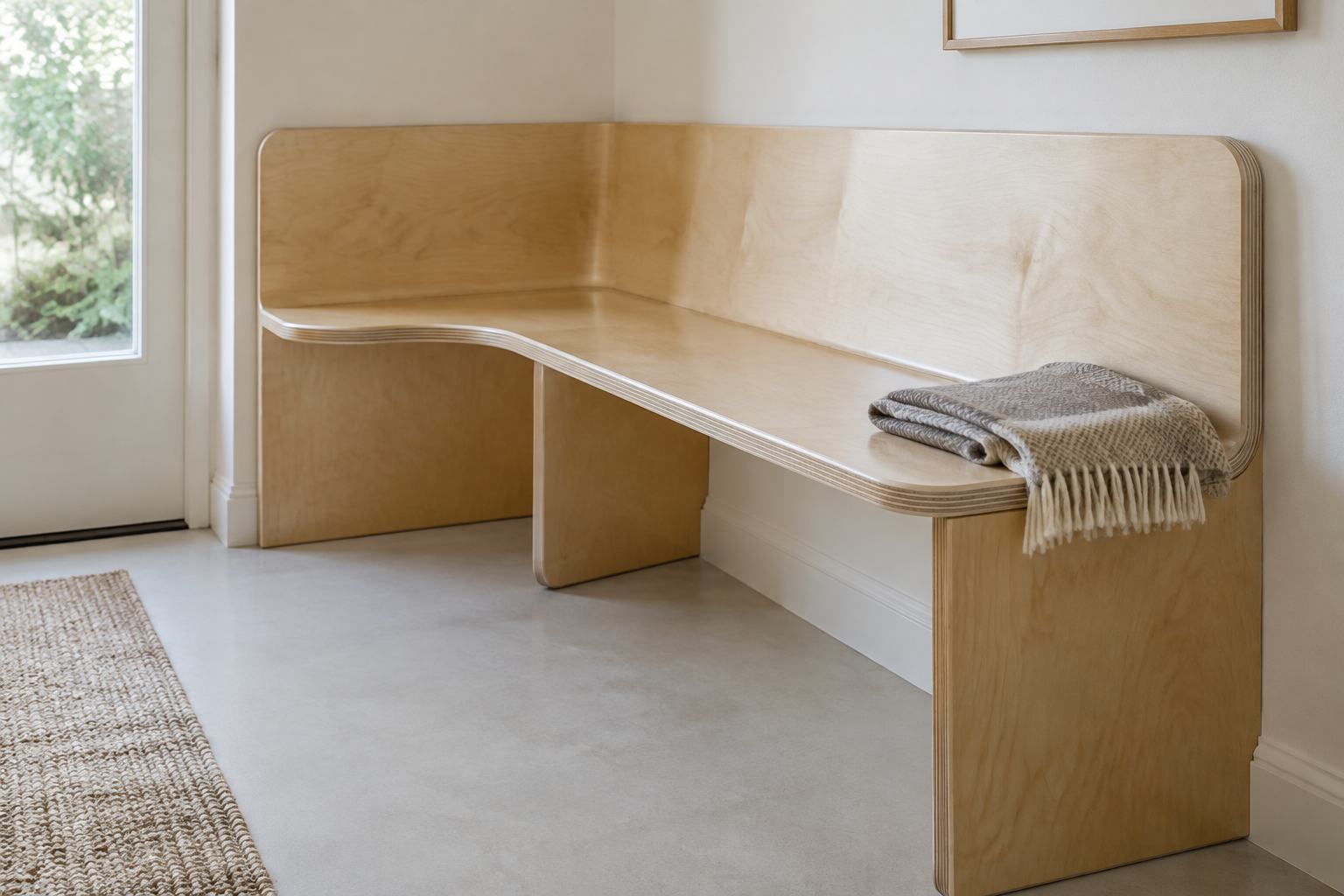
Idea 06
Curved back plywood bench
Bent plywood lets the backrest curve gently around the sitter instead of digging into the wall. It suits awkward corners where a straight bench leaves gaps.
Pick an 18mm birch ply with a clear lacquer. The layered edge becomes a decorative detail on its own.
Keep the legs simple and thin. The curve is the feature, and anything busier fights it.
Bent plywood entryway bench with a curved backrest tucked into a corner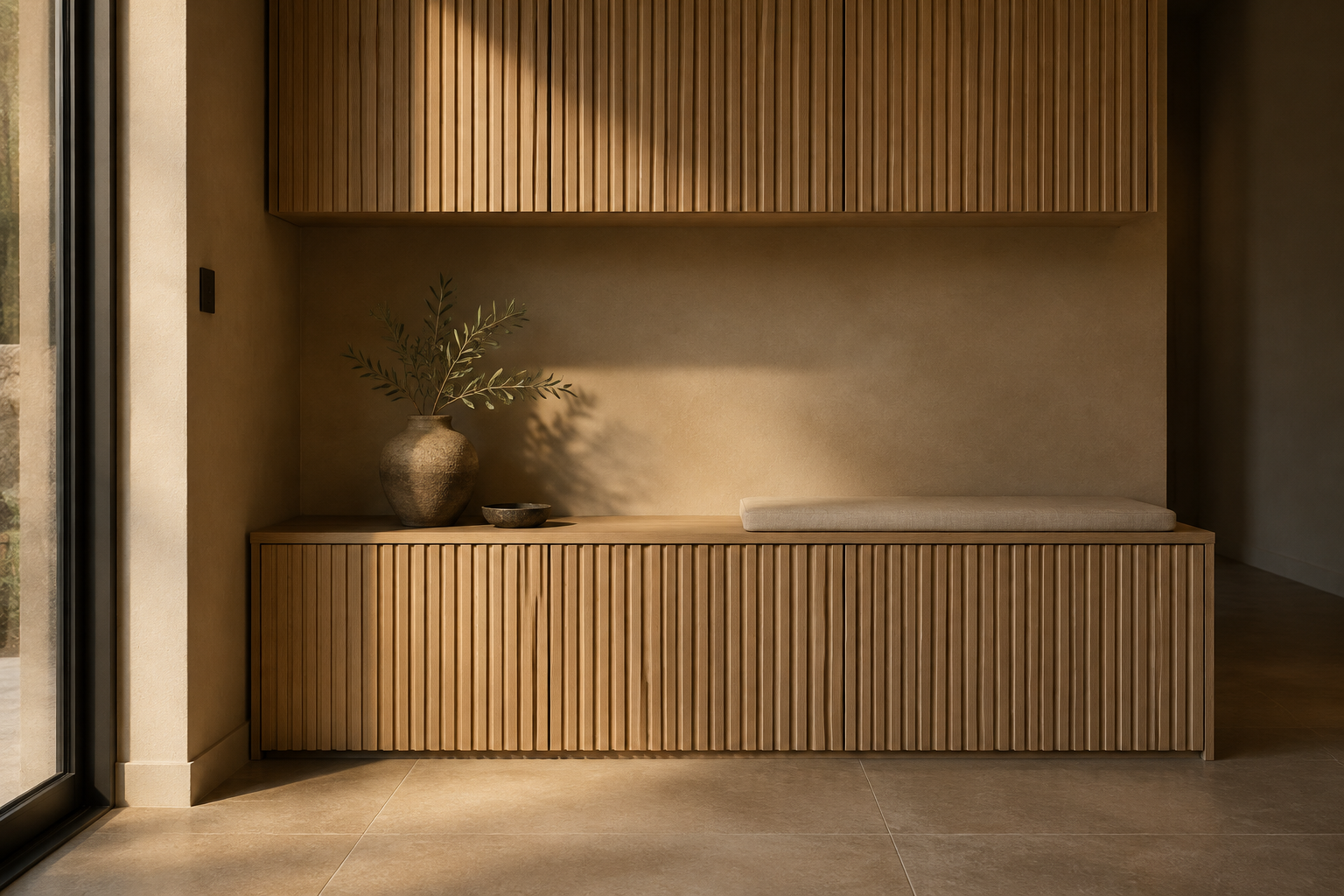
Idea 07
Fluted wood bench
Vertical reeding across the bench front turns a plain box into a textural feature. The shadow lines add depth in low hallway light.
Repeat the same fluting on a cabinet above for a continuous look. One timber, one finish, no exceptions.
Keep the top flat and unadorned. A cushion on fluting ruins the lines you paid for.
Entryway bench with vertical fluted reeded wood front and a matching cabinet above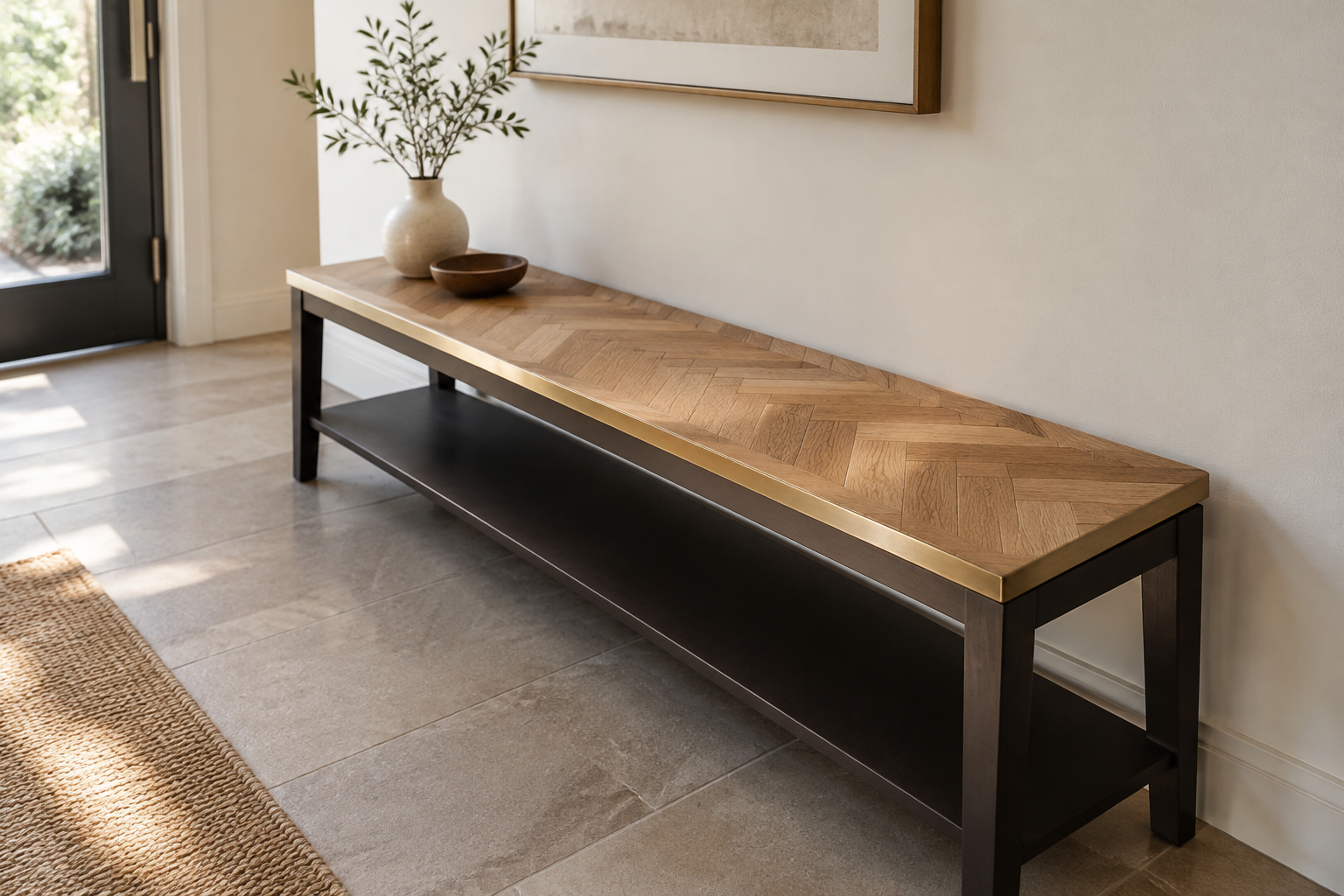
Idea 08
Herringbone oak with a brass edge
A herringbone top made from oak offcuts gives the bench a crafted, almost flooring-like surface. A thin brass strip along the front edge catches light as you walk past.
Keep the base simple and dark. All the attention belongs on the pattern.
Add a narrow shelf below rather than drawers. A lighter base lets the top stay the hero.
Herringbone oak entryway bench with a thin brass strip along the front edgeBuilt-in, mudroom and storage benches
If your hallway has a coat pile problem, this is the section that solves it. Every idea here hides something.
Idea 09
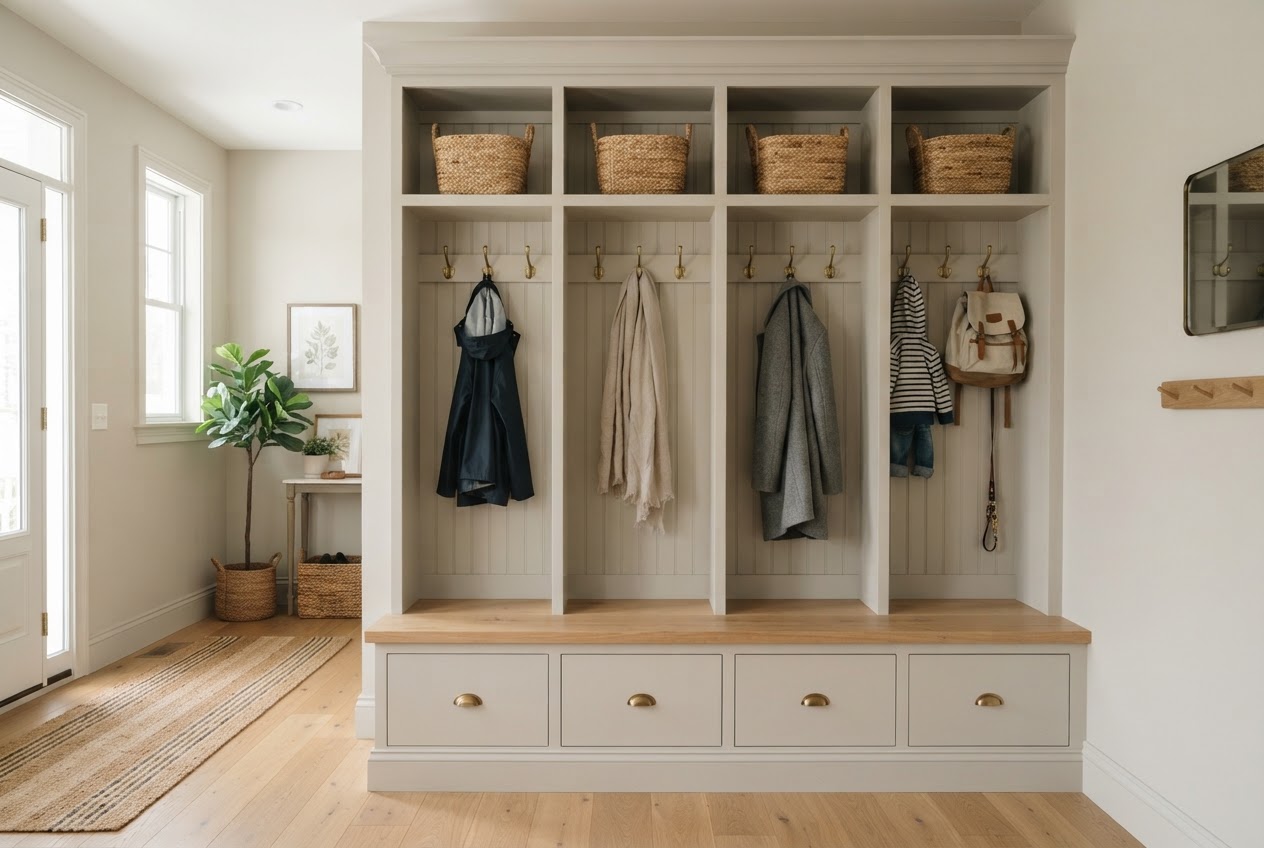
Full-wall mudroom with four cubbies
Four open lockers above a continuous bench give each person their own drop zone. Hooks, a high shelf and a drawer under each seat handle coats, hats and shoes.
Paint the whole unit the same colour as the wall. It visually disappears and makes a small mudroom feel bigger.
Leave 40cm of bench under each locker so two people can sit at once without negotiating.
Built-in mudroom with four open lockers above a continuous bench painted the wall colour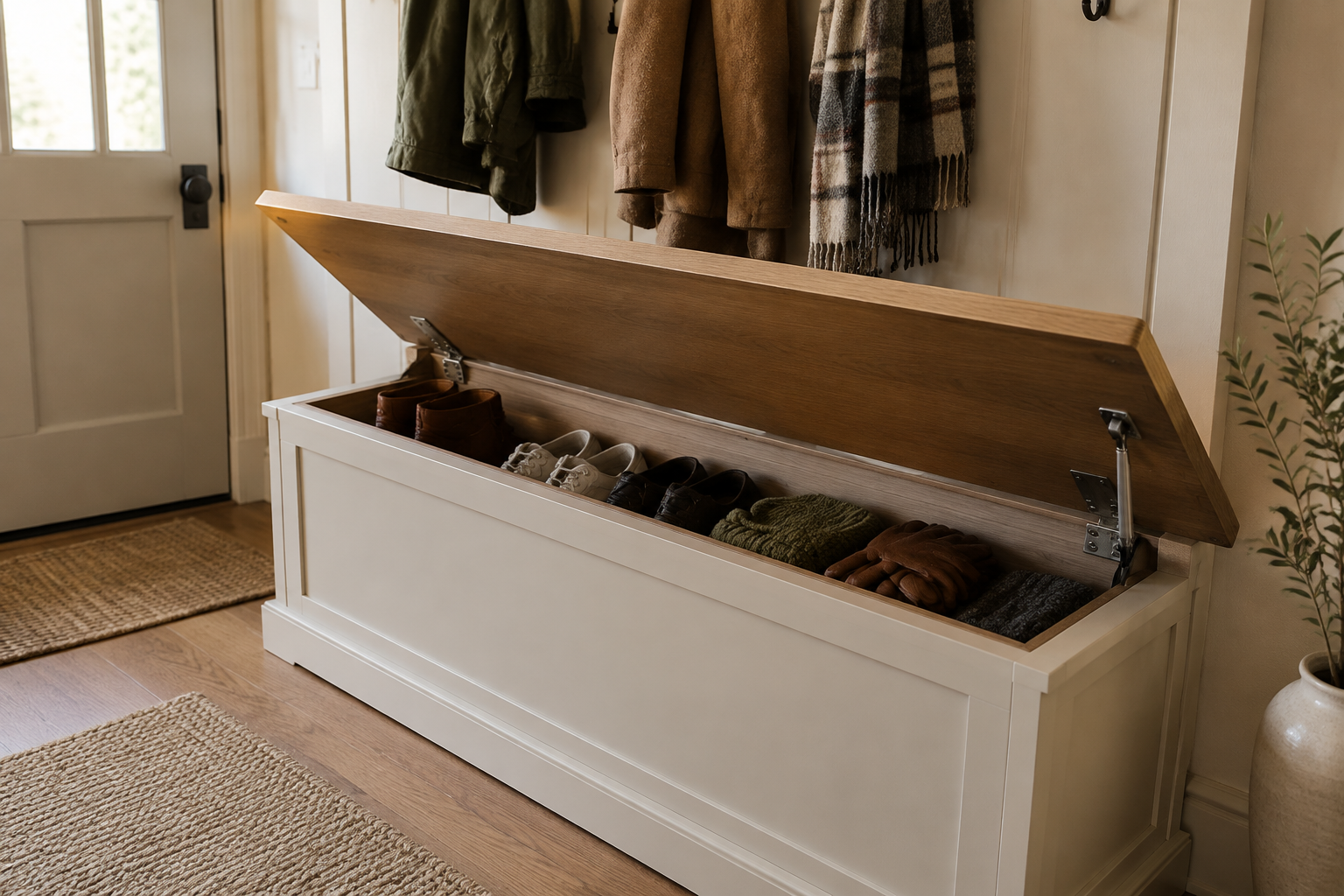
Idea 10
Bench with a hidden hinged lid
Lift the seat and the entire bench becomes a storage box for shoes, gloves and bags. A soft-close hinge stops the lid slamming on small fingers.
Add a finger pull notch instead of a handle. It keeps the front face completely unbroken.
Line the inside with a wipeable surface. Whatever goes in will be damp at least half the year.
Wooden entryway bench with the seat lifted open showing hidden storage inside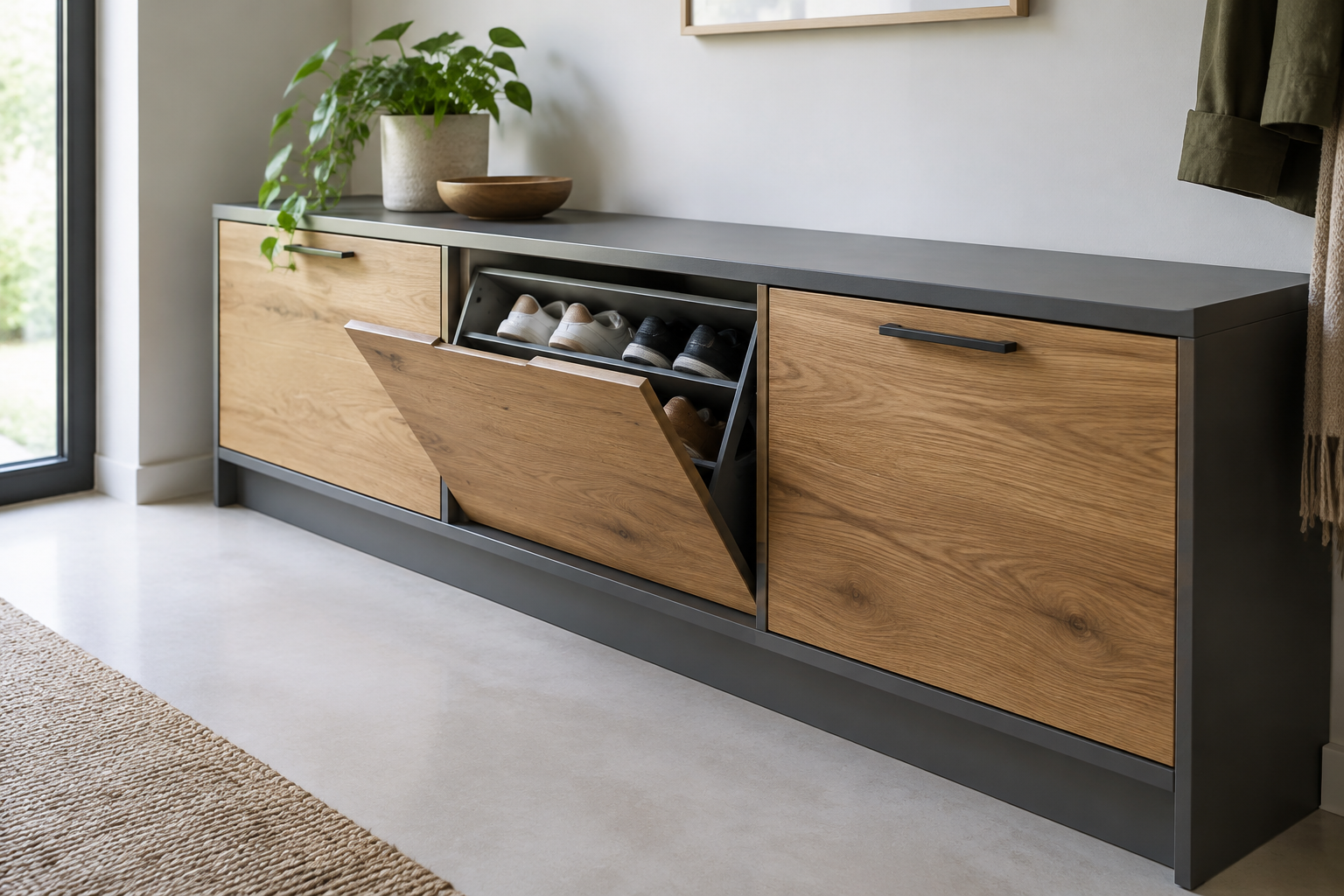
Idea 11
Tilt-out shoe drawer stack
Three tilt-out drawers hold around 24 pairs of shoes at ankle height. Nothing needs to be pulled out to reach the back row.
Line each drawer with a washable mat. Street grit destroys the mechanism before anything else fails.
Choose a powder-coated steel mechanism over plastic. The difference in feel is immediate.
Entryway bench with three tilt-out shoe drawers lined up below the seat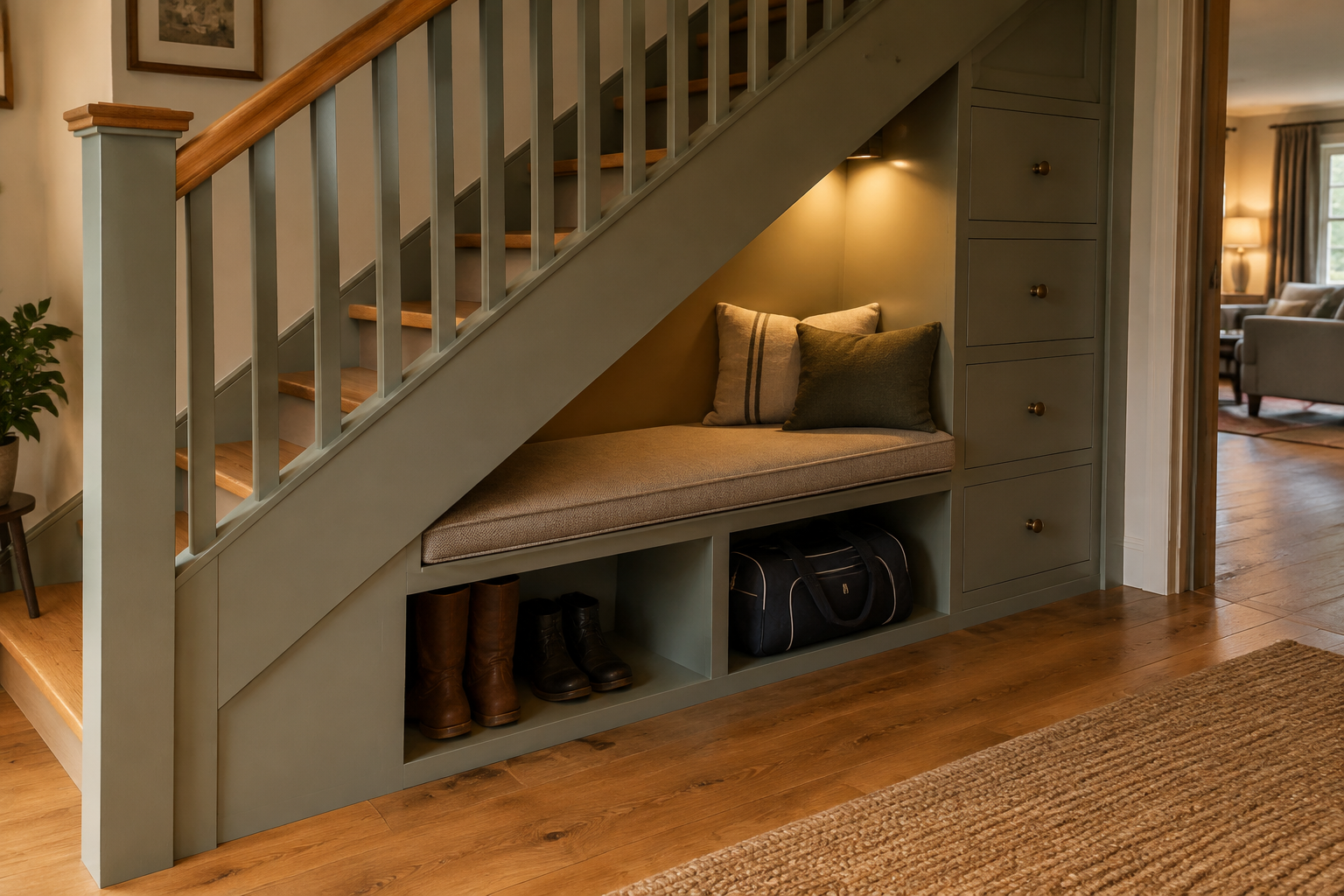
Idea 12
Under-stair bench nook
The triangle under a staircase is dead space until a bench goes in. Build the seat to the slope and put drawers in the tall end.
Keep the deepest section for boots and sports gear. That is where the awkward shapes naturally live.
Add a small light under the stair soffit. That corner is always darker than you think.
Storage bench built into the space under a staircase with drawers in the tall end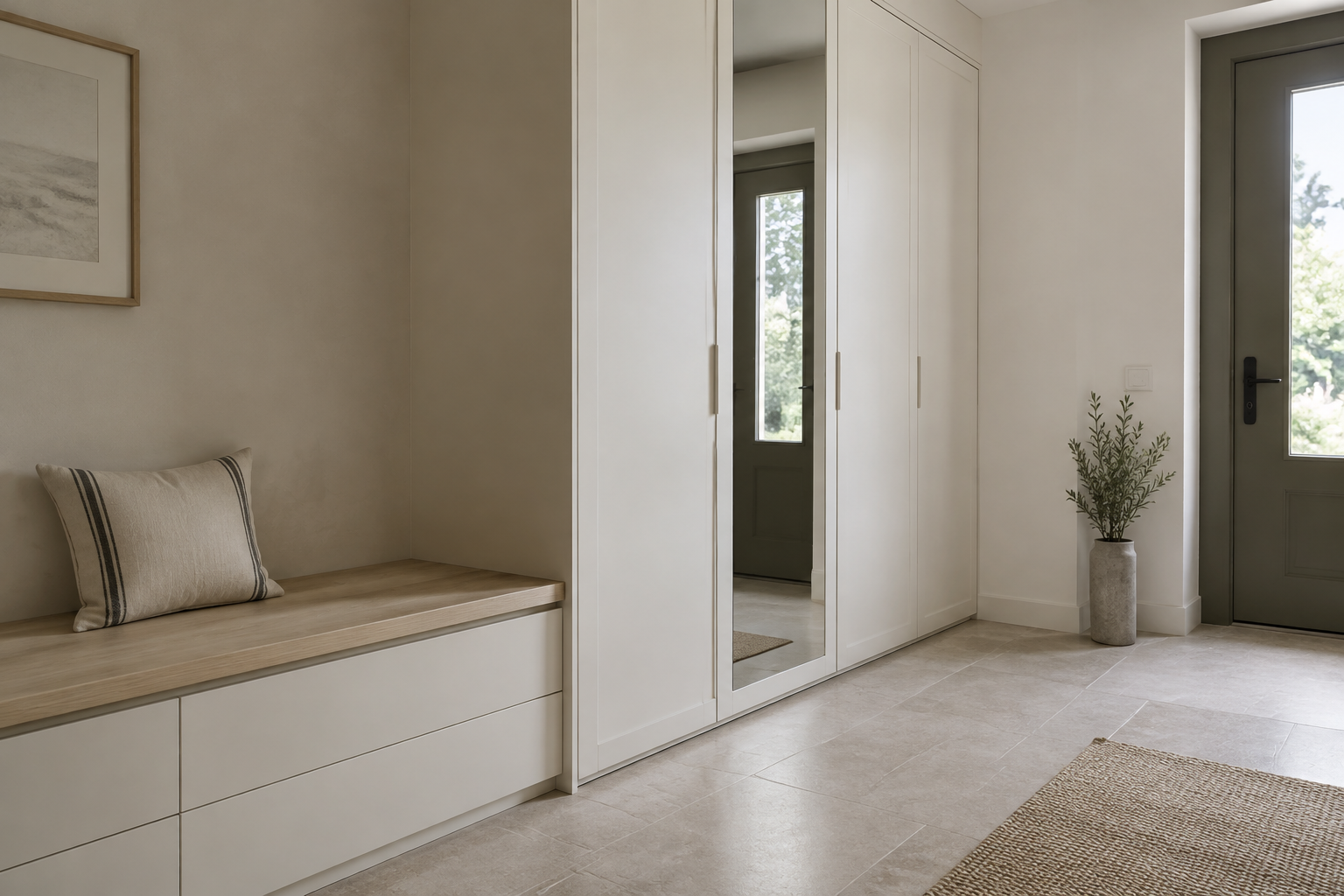
Idea 13
Bench with a tall coat cabinet
A bench on one end and a full-height wardrobe on the other solves coats and seating in one footprint. The cabinet hides everything behind a single door.
Fit a mirror to the cabinet door. It doubles as a last-look checkpoint on the way out.
Keep the cabinet depth at 60cm. Deeper wastes hallway, shallower will not take a hanger.
Entryway with a bench on one end and a full height closed coat cabinet on the other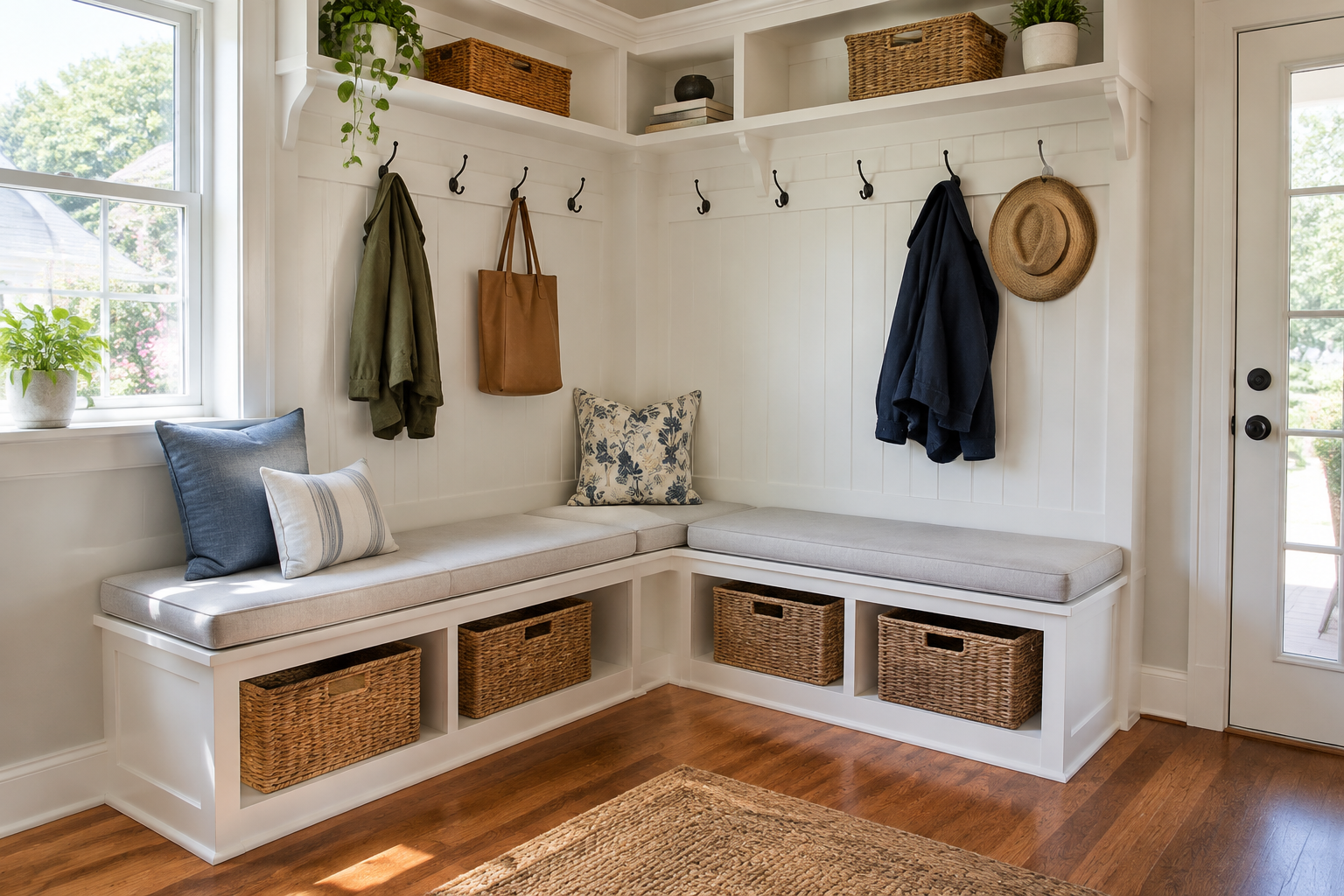
Idea 14
L-shaped corner mudroom
Two short benches meeting in a corner create a generous seating run without blocking traffic. The corner bay becomes the natural home for baskets.
Use a wedge cushion in the corner so the seat still feels continuous. Sharp inner angles simply go unused.
Choose one basket per person and name them. Unlabelled baskets turn into a shared mess by week two.
L shaped corner mudroom bench with corner cushion and baskets in a light hallway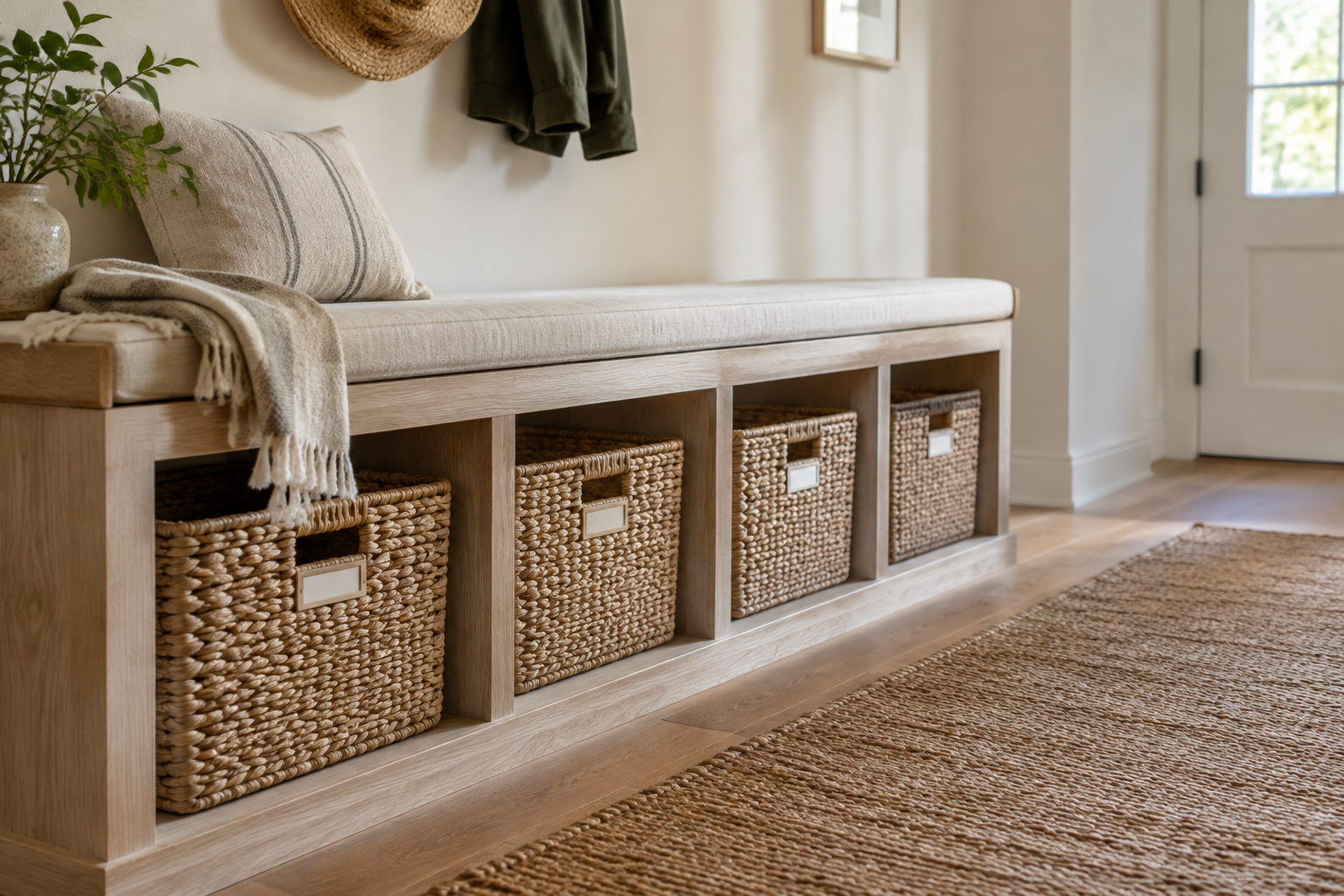
Idea 15
Bench with open basket bays
Open bays under the seat hold woven baskets that slide out like drawers. It is storage that stays flexible as the household changes.
Label the baskets by person or by season. Untidy systems fail within a month.
Stick to one basket style. Three different weaves start to look like a lost and found.
Entryway bench with open bays below holding woven storage baskets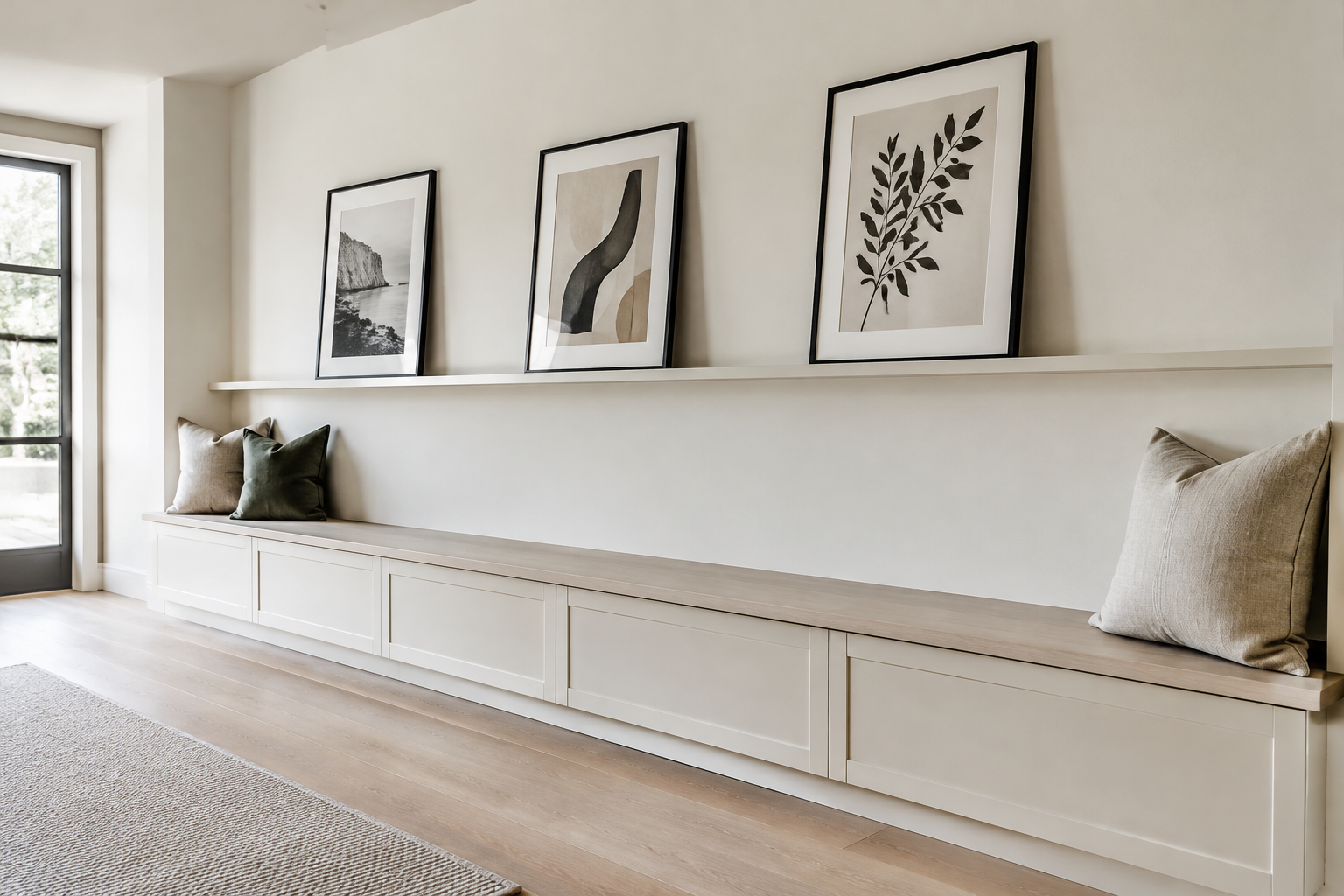
Idea 16
Wall-to-wall bench with a gallery ledge
A bench running the full width of the wall reads as architecture rather than furniture. A narrow ledge above holds frames without hooks puncturing the plaster.
Keep the ledge shallow. Anything deeper starts to feel like a shelf you have to dust.
Lean the frames rather than hanging them. It looks considered and lets you change your mind.
Wall to wall entryway bench with a narrow picture ledge of frames above itUpholstered and soft benches
Soft seating changes how long people stay in a hallway. These eight ideas trade a little storage for a lot of comfort.
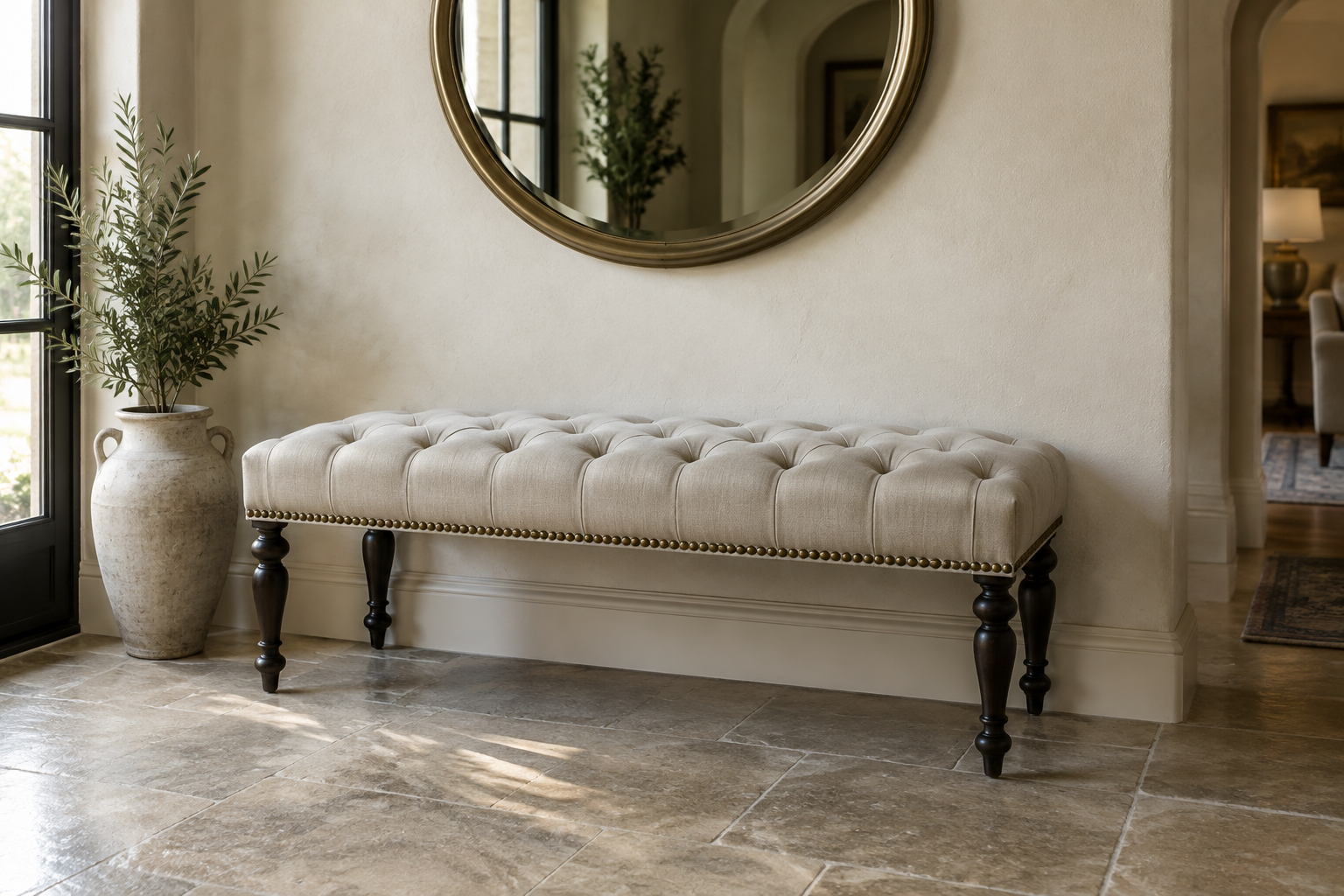
Idea 17
Tufted linen with nailhead trim
Diamond tufting in natural linen gives an entryway bench a tailored, hotel-lobby feel. A line of brass nailheads frames the shape.
Choose a linen blend rated above 30,000 rubs. Pure linen looks beautiful and wears through in a hallway.
Keep the legs turned and dark. Brass and dark timber are the two finishes this design wants.
Diamond tufted natural linen entryway bench with brass nailhead trim along the frame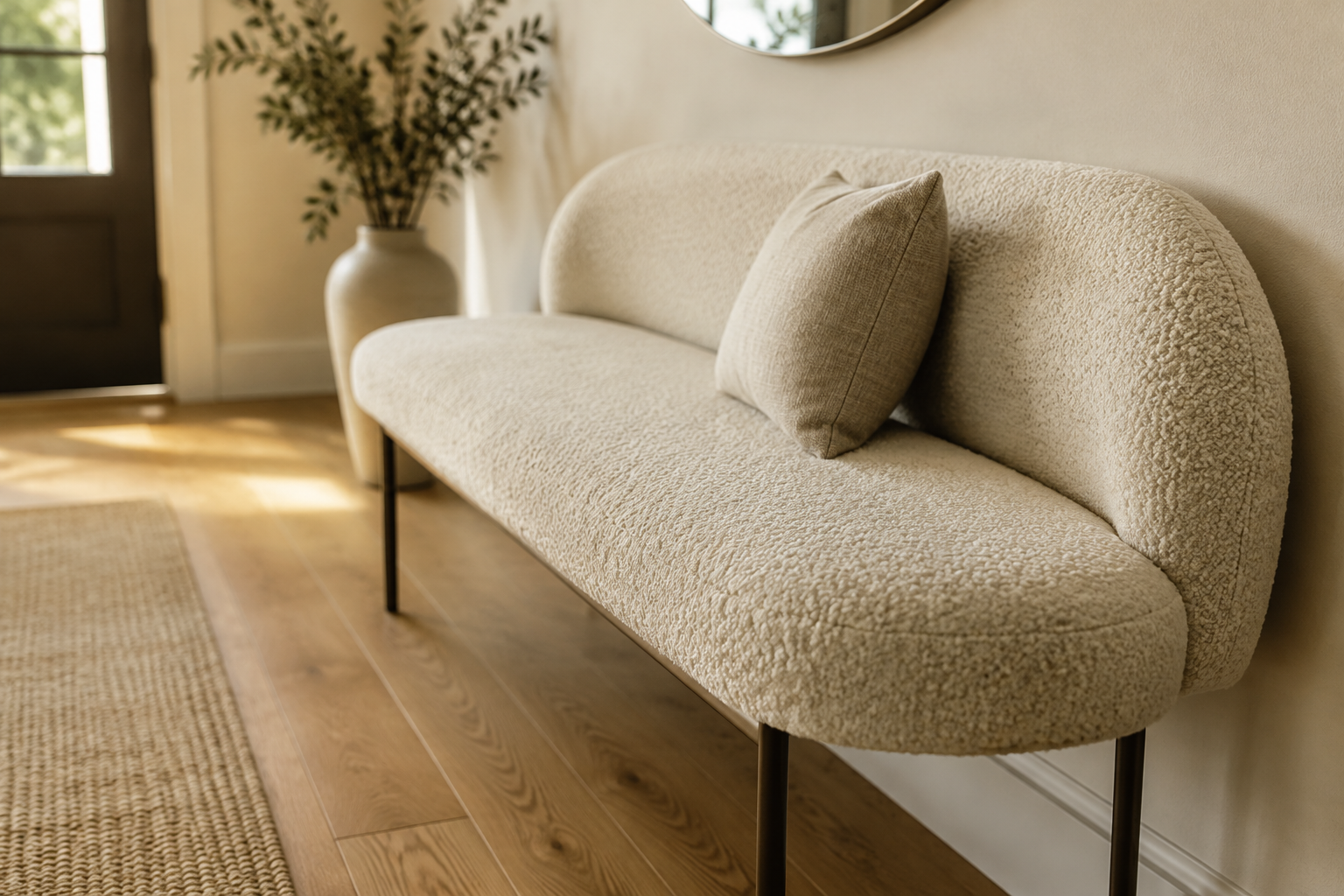
Idea 18
Bouclé bench with a curved back
Bouclé is all texture, and a curved back turns the bench into something you want to touch. Cream keeps it light in a dark corridor.
Keep the legs slim and dark so the soft mass does not float. Contrast is what stops it looking like a cloud.
Add one tonal cushion only. Bouclé plus pattern is too much in a small space.
Cream boucle upholstered entryway bench with a rounded curved backrest and slim dark legs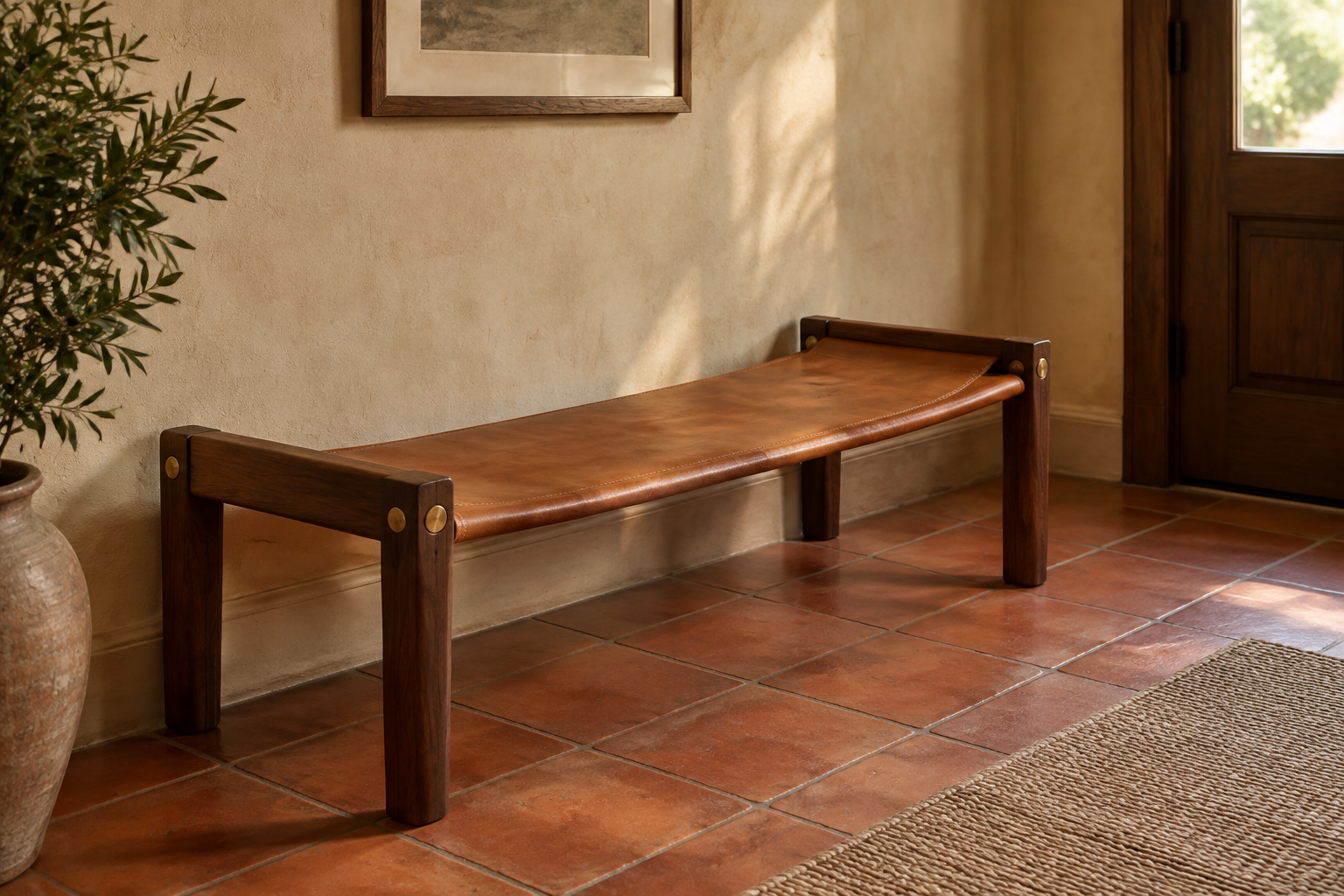
Idea 19
Leather sling bench
A single tan leather panel slung between two walnut rails forms the seat. It softens slightly with use and picks up a warm patina.
Wipe it with a dry cloth weekly. Leather in an entryway needs almost nothing else.
Keep the frame visible and the hardware brass. The tension in the sling is the design.
Tan leather sling seating entryway bench on a solid walnut frame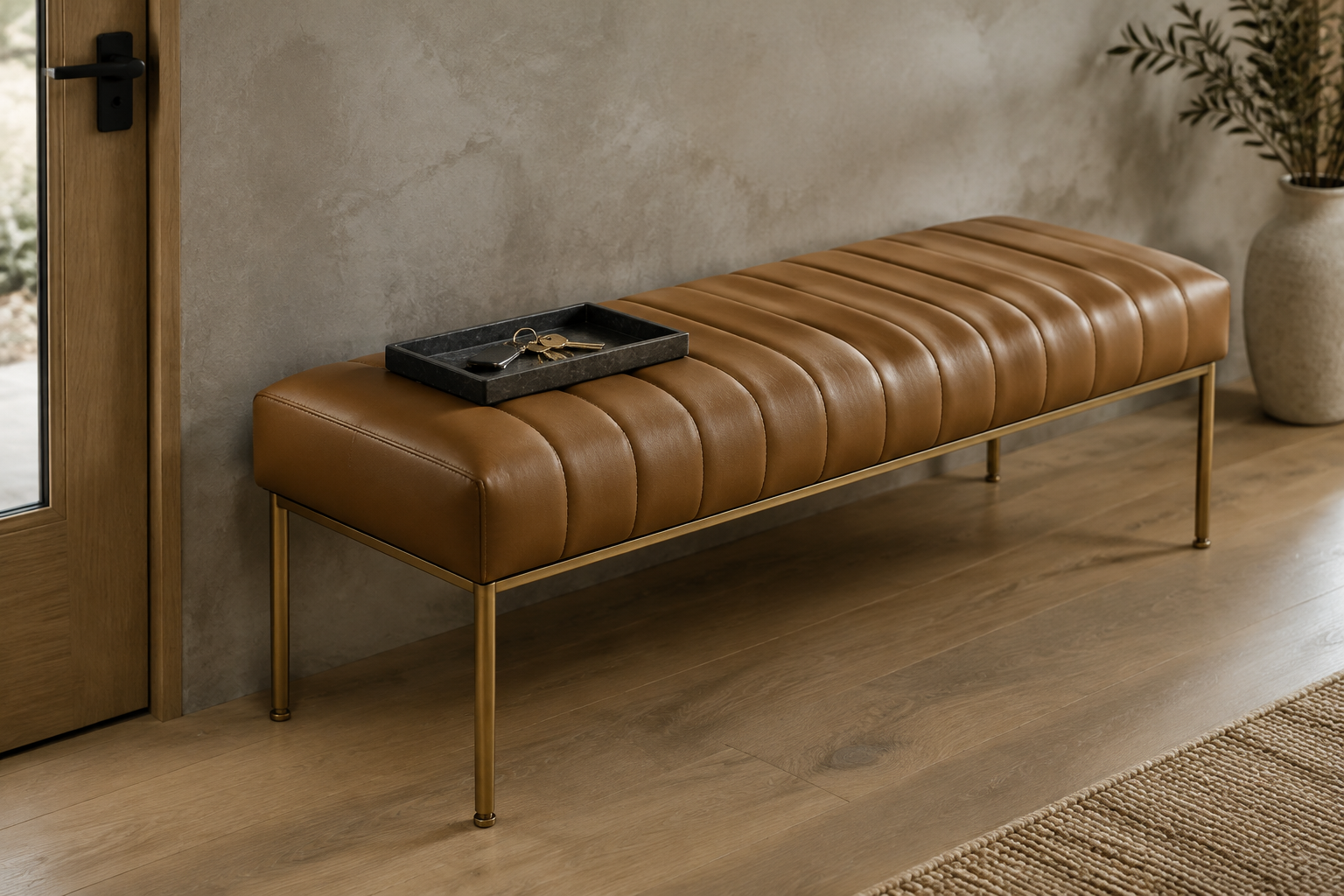
Idea 20
Camel leather on brass legs
Horizontal channel tufting in camel leather looks warm, deliberate and quietly expensive. Thin brass legs lift the mass off the floor.
Specify lacquered brass or you will be polishing it monthly. Nobody keeps that up.
Put a dark stone tray on the seat for keys. Soft leather and hard stone belong together.
Camel leather channel tufted entryway bench with thin brass legs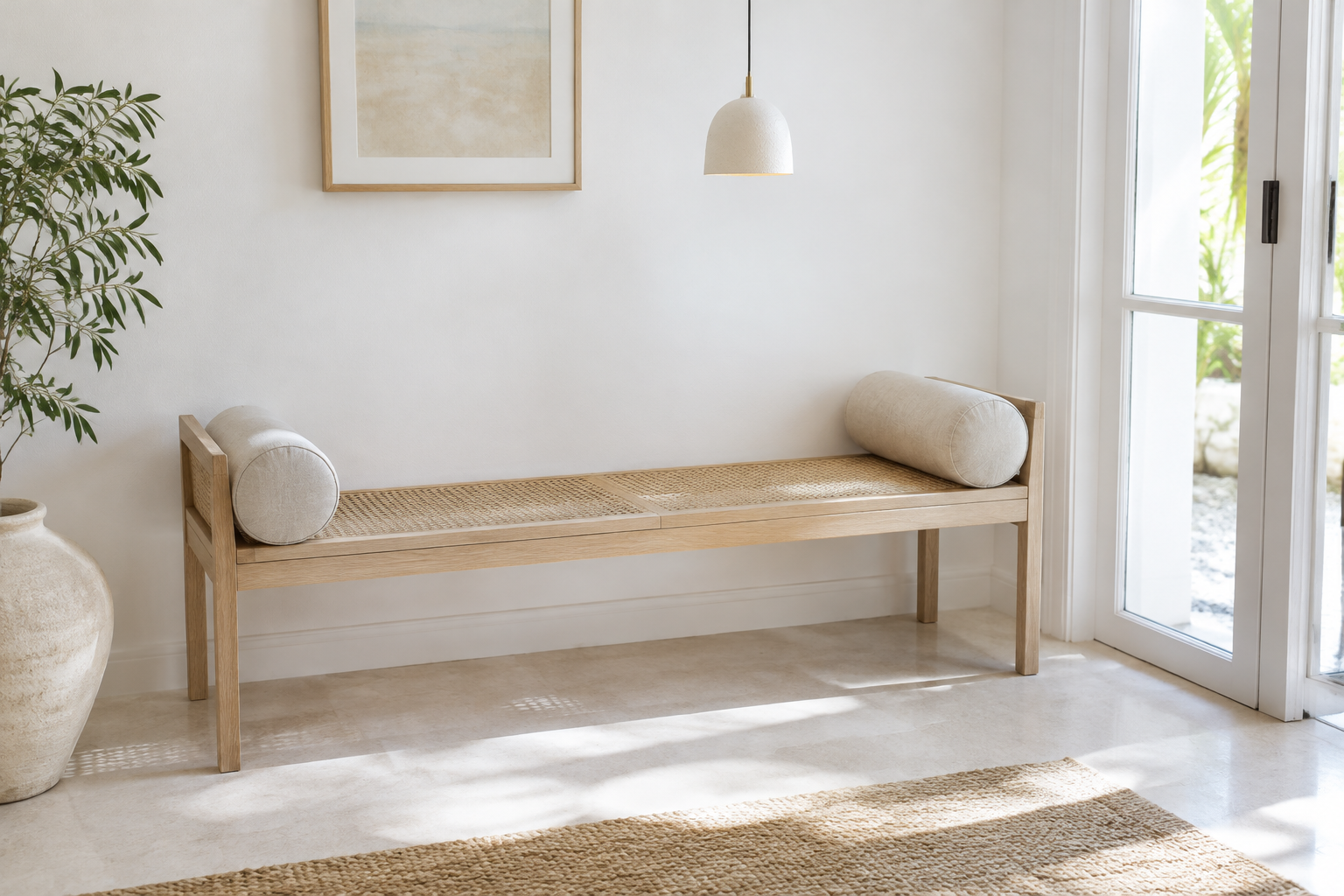
Idea 21
Cane webbing bench with bolsters
Cane webbing gives a light, breathable seat that suits small hallways. Two cylindrical bolsters lean into each corner with no fixing needed.
Keep the frame pale oak. Cane looks best when it is the only pattern in the room.
Check the cane tension before buying. Loose webbing sags within a year of daily use.
Pale oak entryway bench with cane webbing seat and two cylindrical bolster cushions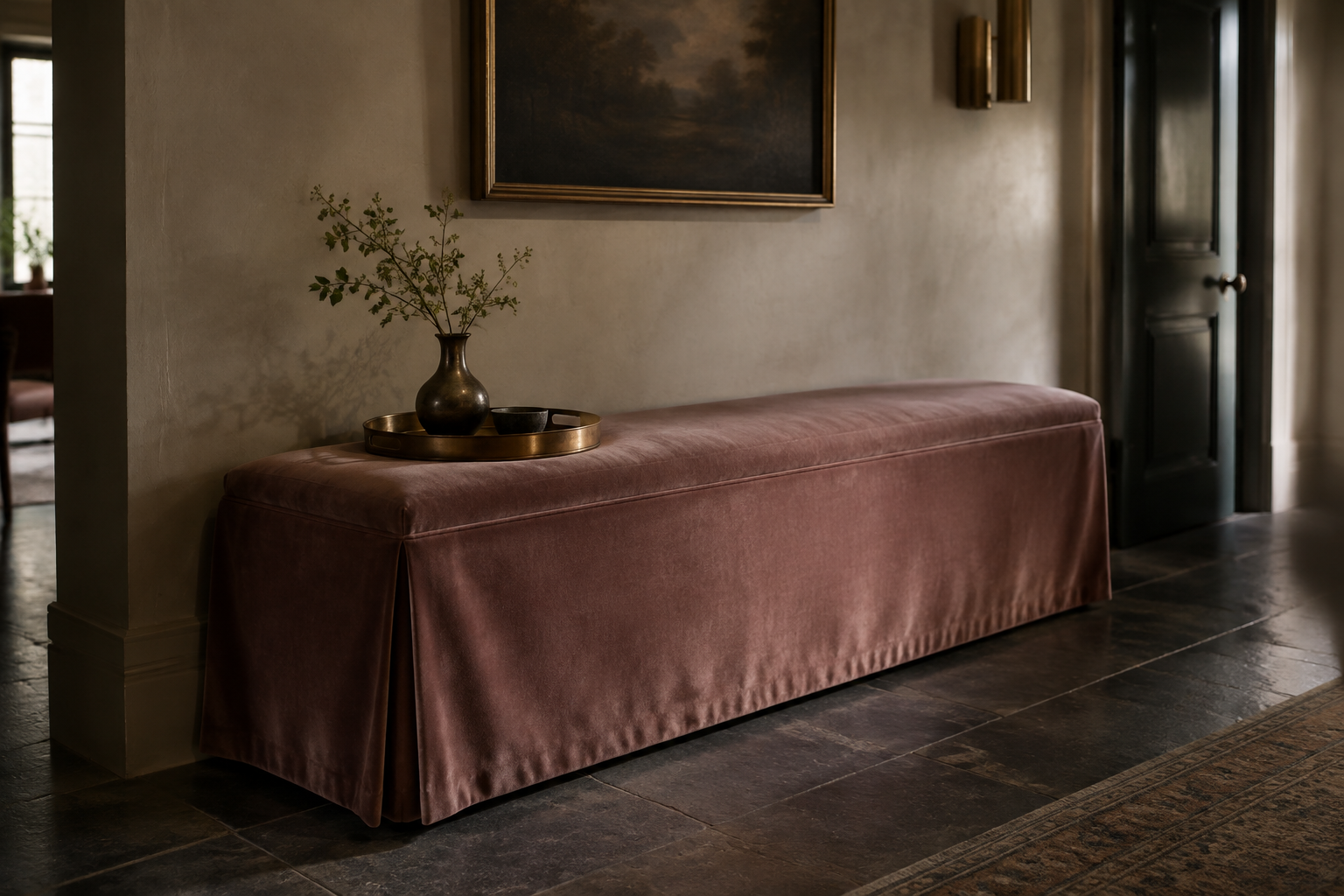
Idea 22
Velvet bench with a floor-length skirt
A floor-length skirt turns a bench into a soft block with no visible legs. Everything stored underneath simply disappears.
Pick velvet in a mid tone, because pale velvet shows every handprint within a week.
Add a hard tray on top for keys. Softness everywhere gets tiring fast.
Muted velvet entryway bench with a floor length skirt hiding everything underneath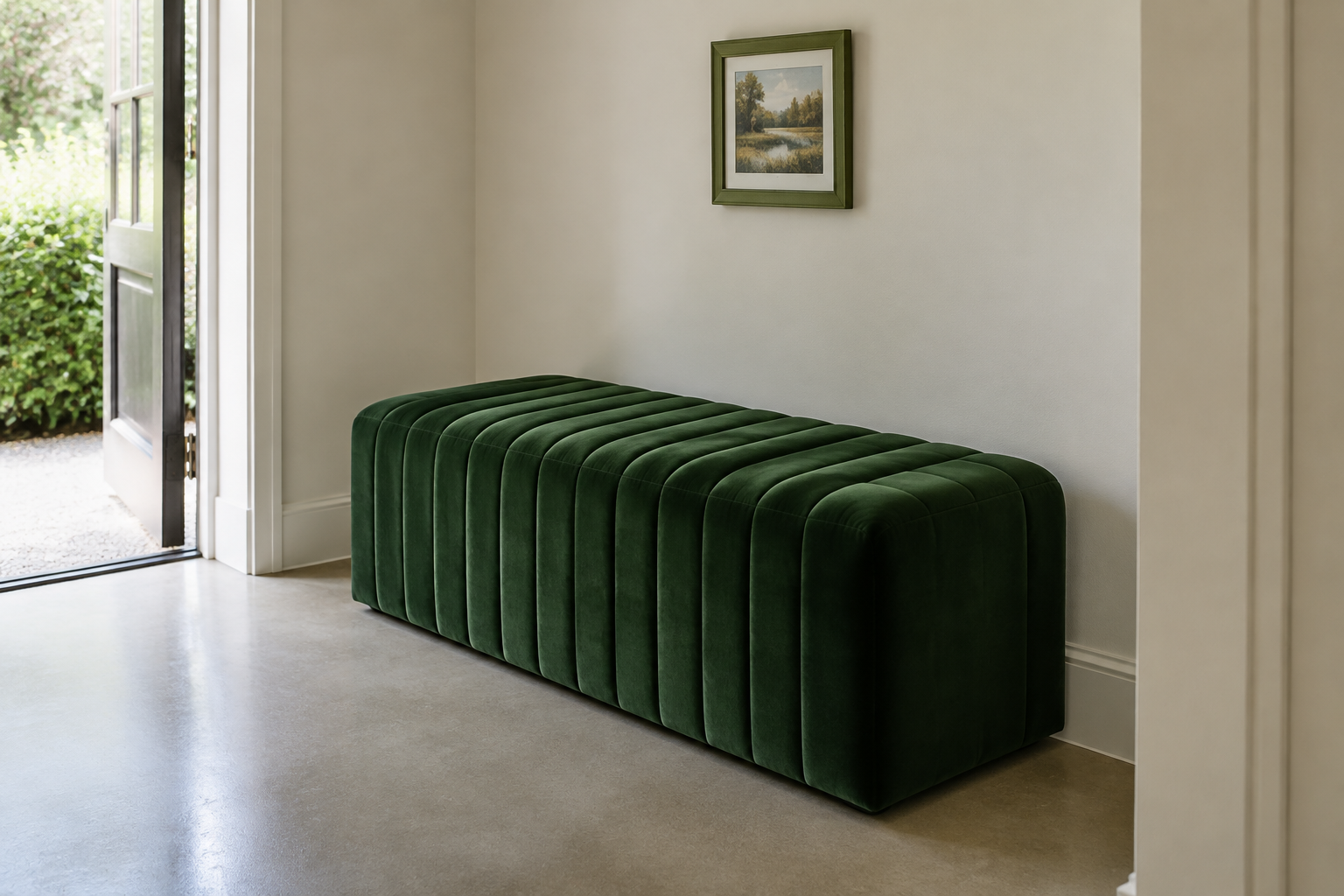
Idea 23
Deep green channel tufting
Vertical channels in deep forest green are dramatic without being loud. The colour grounds an otherwise pale hallway.
Repeat the green once more in the room, in a frame or a small cushion. One bold colour alone can look accidental.
Keep the floor bare around it. Dark upholstery plus a busy rug is a lot in a tight space.
Deep forest green vertically channel tufted entryway bench against pale walls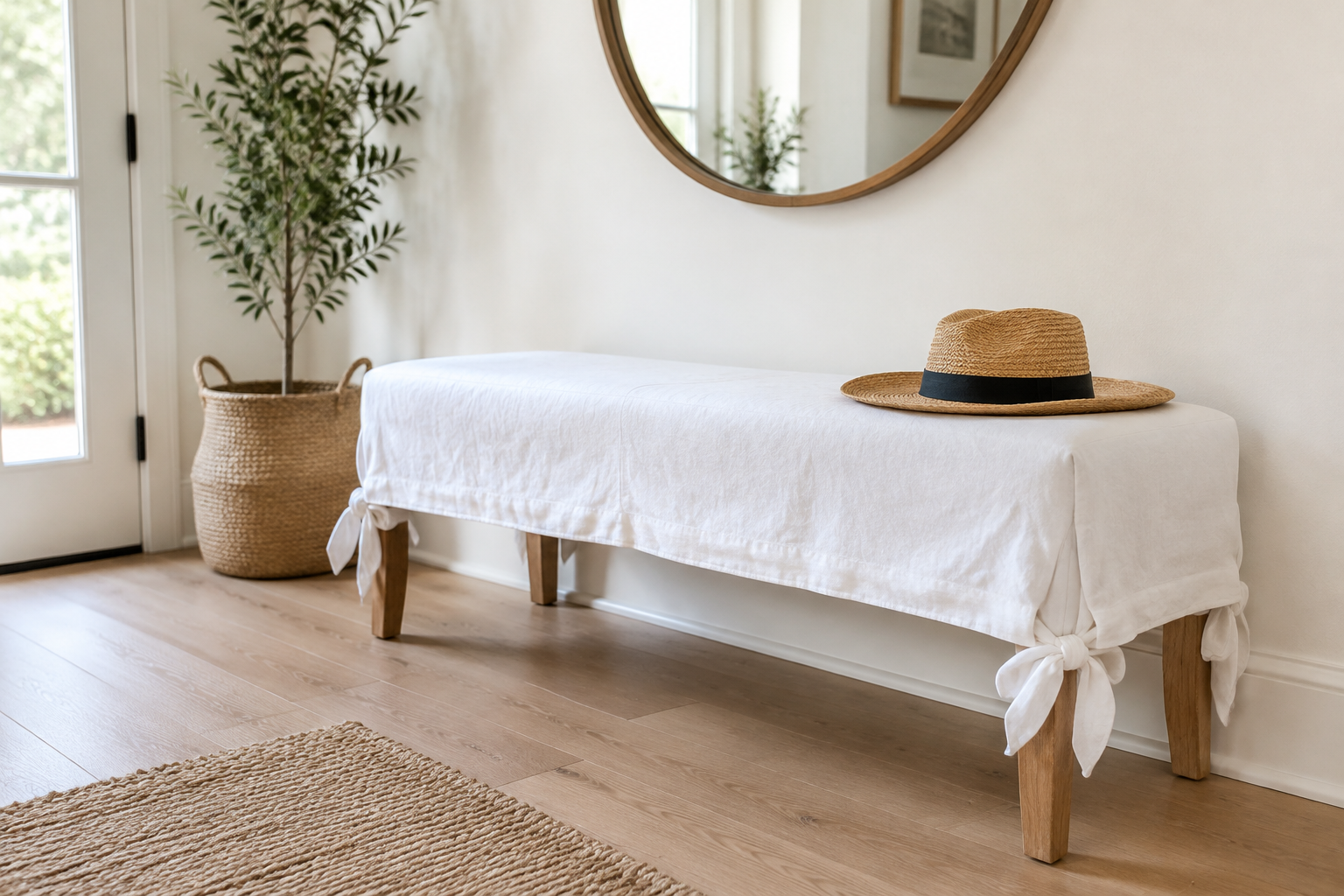
Idea 24
Bench with a removable slipcover
A washable cotton slipcover means a hallway bench can survive muddy seasons. Tie it at the legs so it stays crisp.
Buy two covers at the start. The second one gets you through laundry day.
Pre-wash both before first use. Cotton shrinks once, and you want that to happen before fitting.
Entryway bench with a washable white cotton slipcover tied at the legsSmall space and narrow hallway benches
Narrow hallways punish furniture that assumes room. These eight ideas are built for corridors where every centimetre is spoken for.
Idea 25
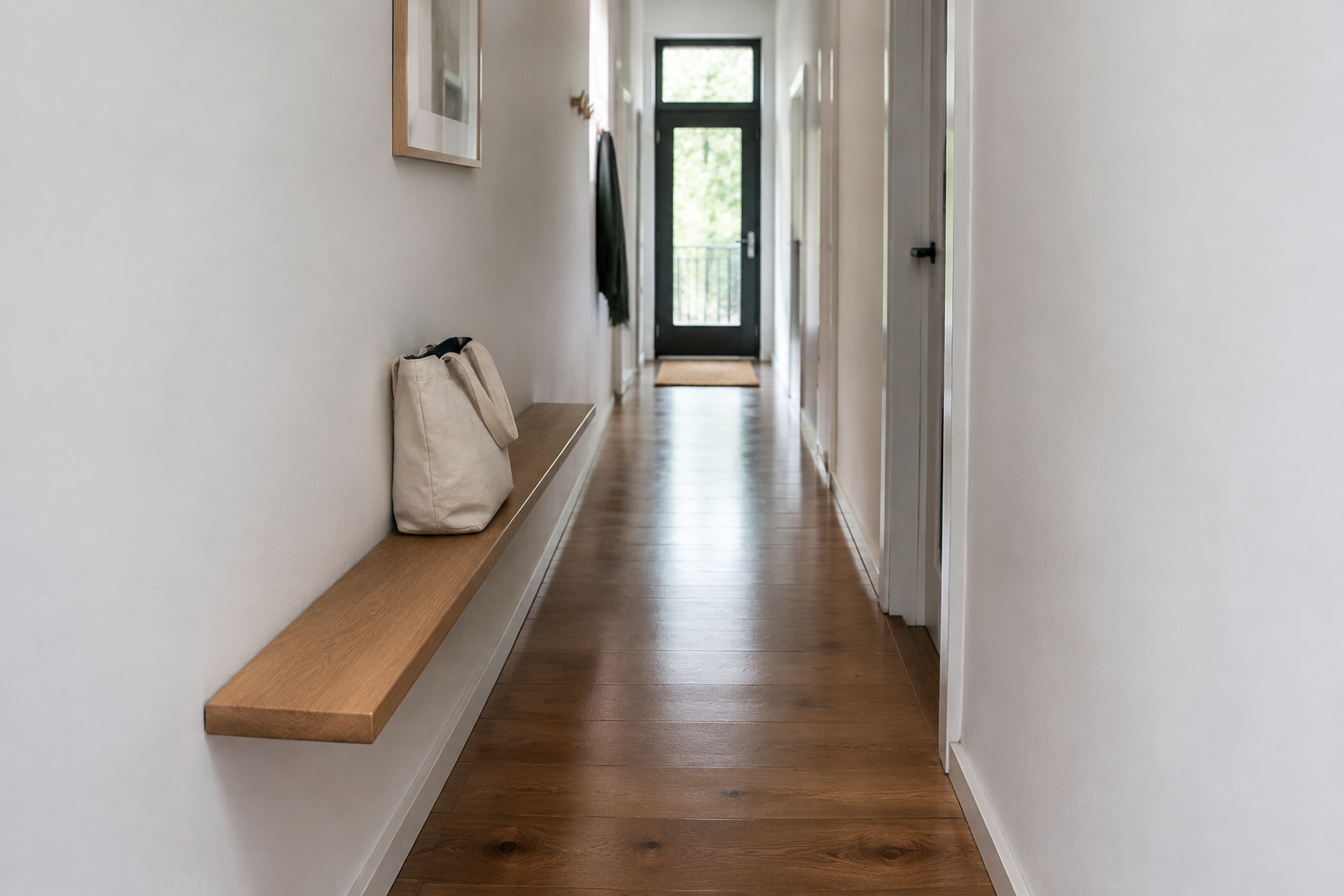
The eight-inch slim bench
A bench only 20cm deep still works as somewhere to balance while you put shoes on. Wall-mounted brackets mean no legs to trip over.
Use it for bags rather than boots. Depth is the limit, so keep the load light.
Round the front edge. A slim bench at hip height is exactly where people walk into things.
Very narrow wall mounted entryway bench only 20cm deep in a tight corridor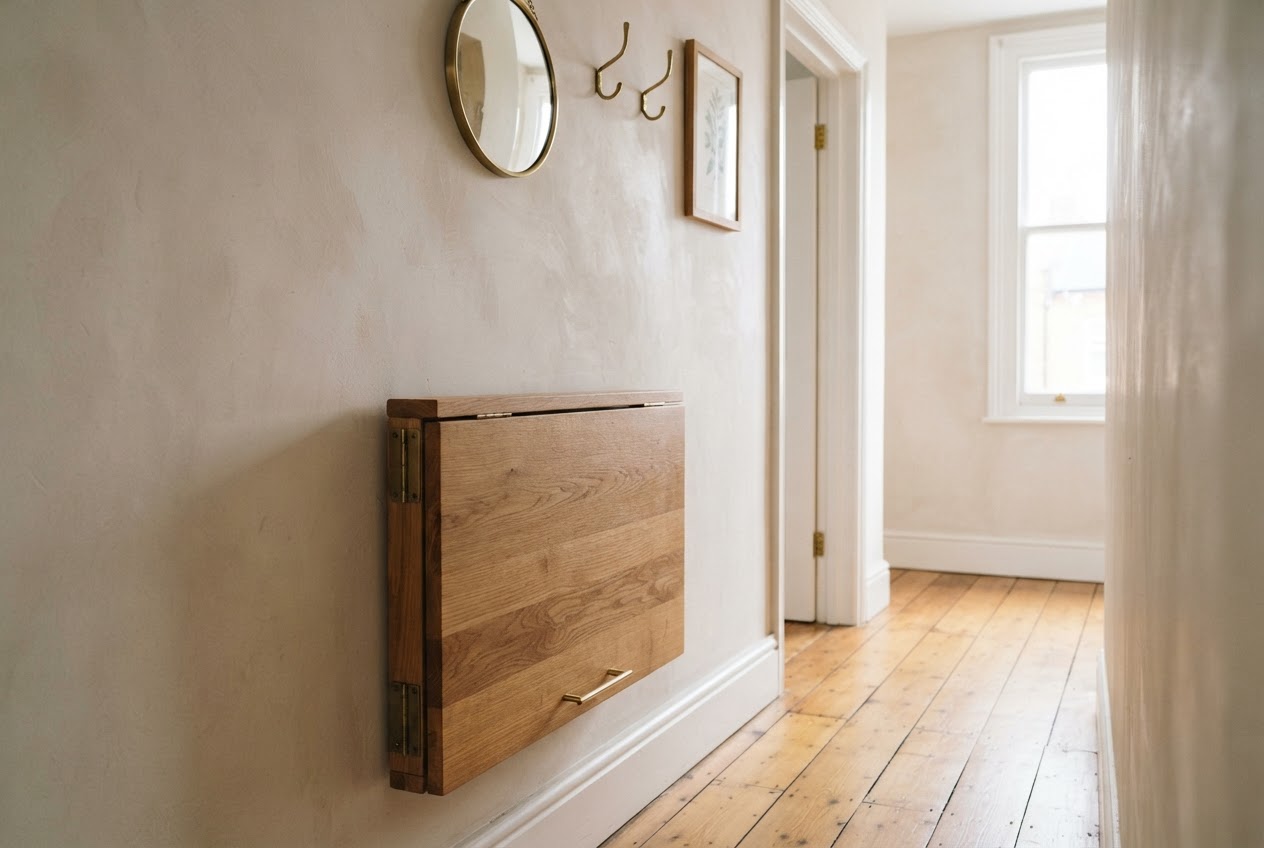
Idea 26
Fold-down wall bench
A hinged bench folds flat against the wall when it is not needed. It is the honest answer for corridors under a metre wide.
Specify heavy-duty hinges so the seat feels solid when open. Cheap hinges flex and feel unsafe.
Add a slim handle that doubles as a towel rail when the bench is up.
Hinged fold down wall bench shown flat against the wall in a narrow hallway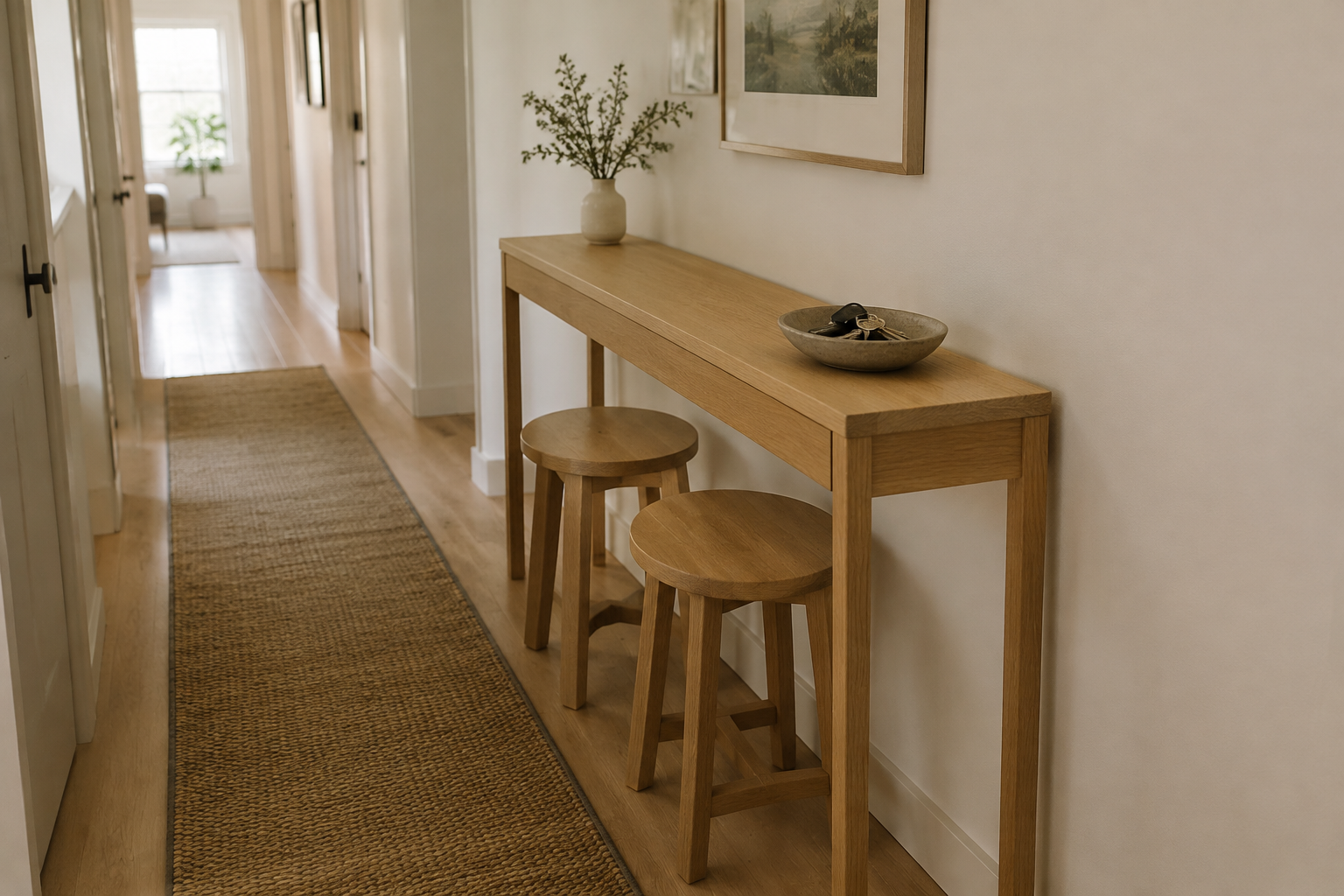
Idea 27
Console and bench hybrid with stools
A narrow console top doubles as seating when two low stools slide underneath. Pull them out for shoes, push them back for space.
Stools should be no more than 5cm lower than the console top to tuck in cleanly. Anything taller will not go.
Choose stools with no arms. Arms are the reason most hallway stools live in a cupboard.
Narrow console with two low stools tucked underneath in a long hallway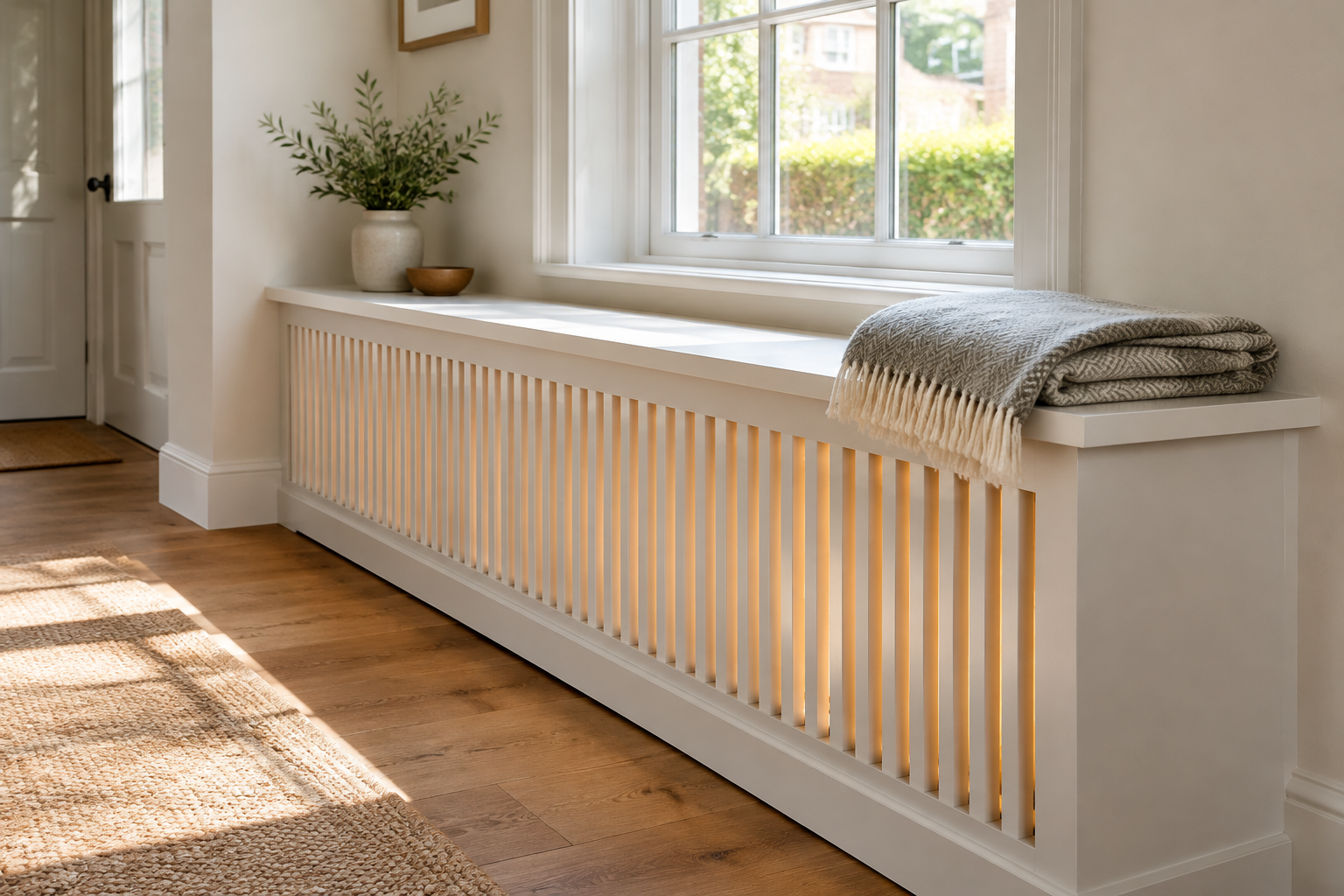
Idea 28
Radiator cover bench
A slatted cover over a radiator becomes a bench that also hides an eyesore. Warm air still rises through the grille.
Leave at least 5cm of clearance around the radiator. Sealed covers cost you heat.
Use a removable top panel. You will need to bleed that radiator at least once a year.
Slatted wooden radiator cover with a bench top in a bright hallway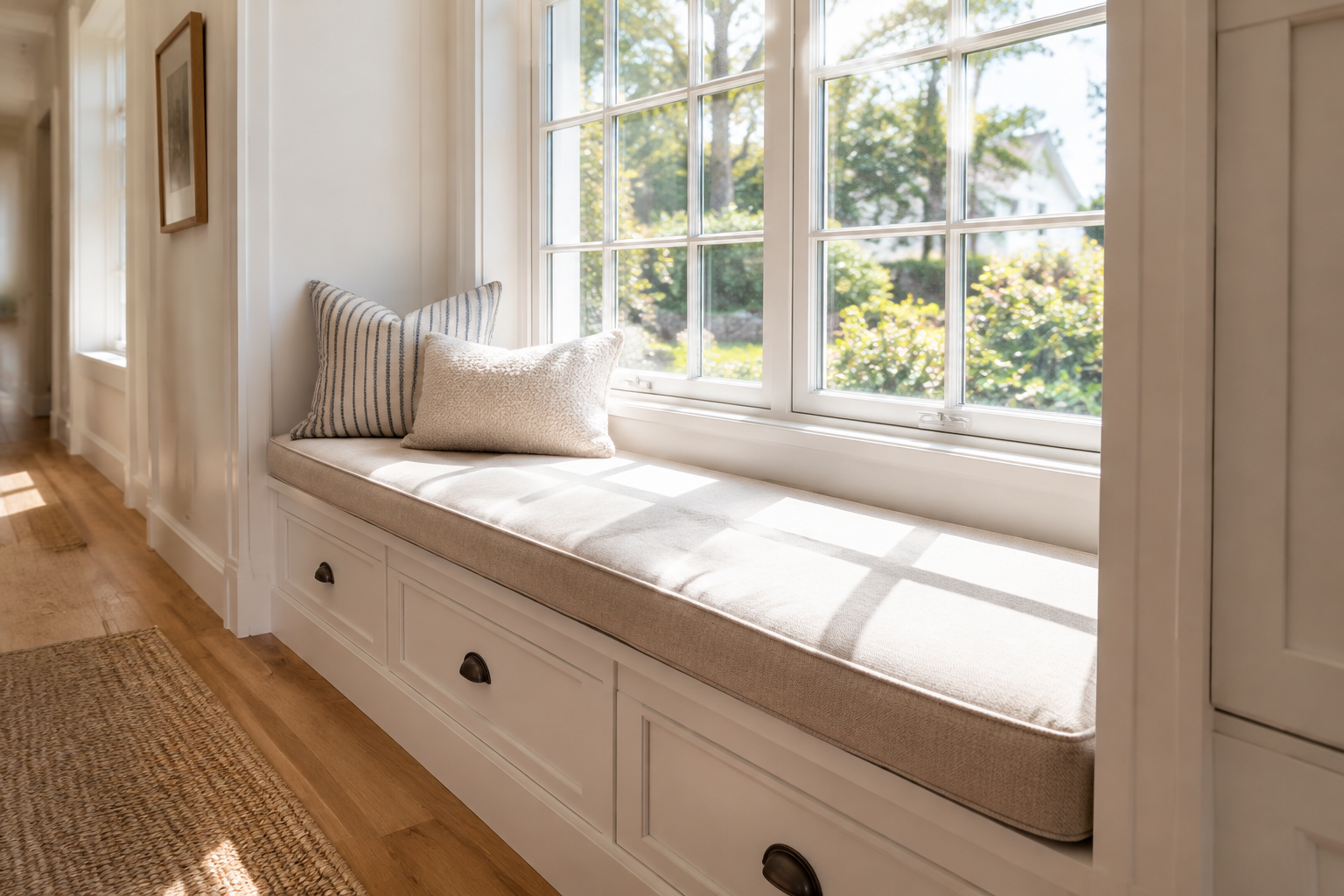
Idea 29
Window seat conversion
An unused hallway window becomes a seat with storage drawers below. Light comes in and the sill finally earns its space.
Use foam at least 8cm thick. Thin cushions on a hard base are uncomfortable after two minutes.
Keep the cushion in a washable cover. Windowsills collect dust and sun damage together.
Hallway window seat with storage drawers below and a thick foam cushion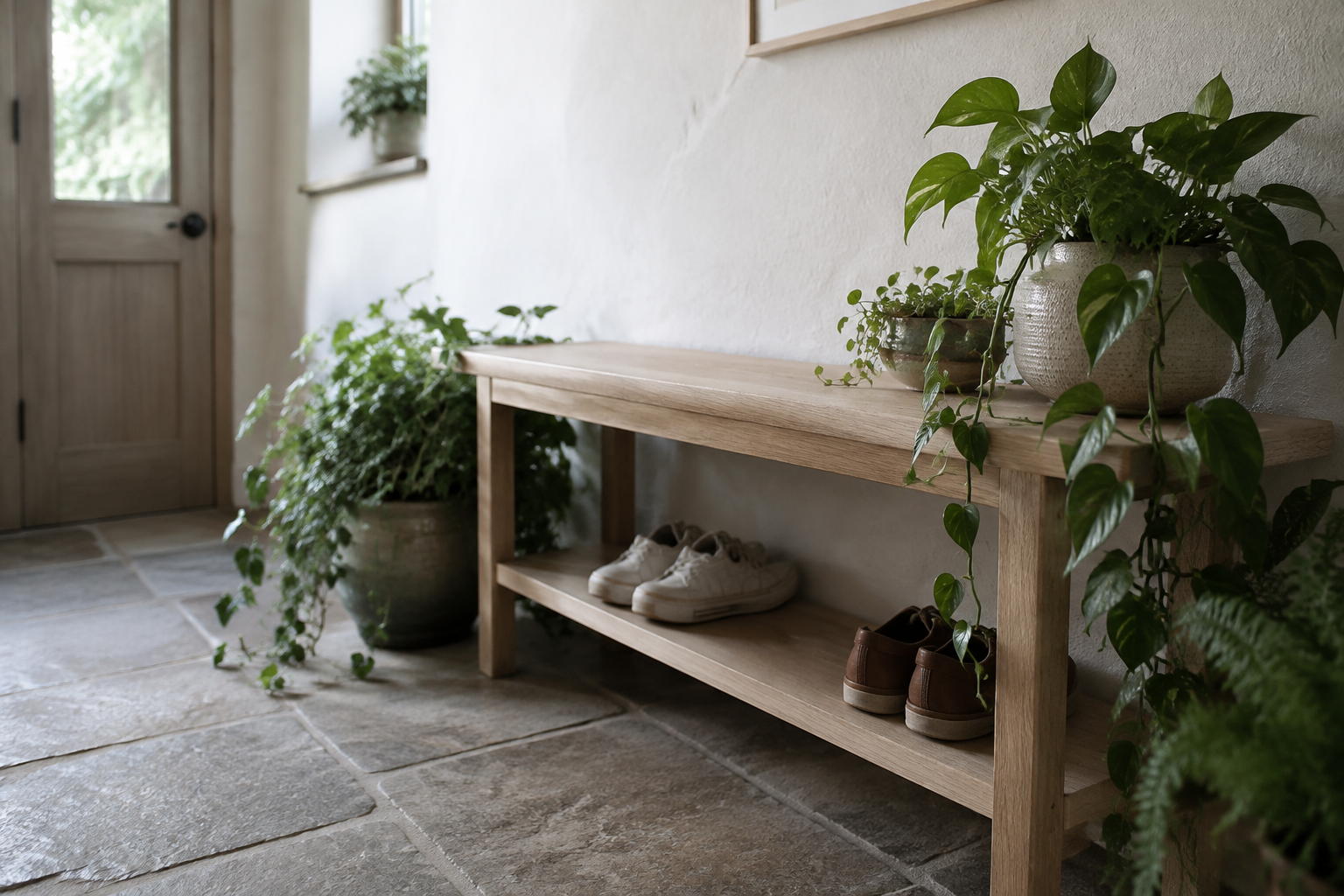
Idea 30
Bench with a plant shelf below
A low shelf under the seat holds shoes and a few trailing plants. Greenery at ankle height softens a hard, narrow hallway.
Choose plants that tolerate low light. Entryways are usually the darkest room in the house.
Water them in the sink, not on the shelf. One spill will mark the timber permanently.
Entryway bench with a low shelf underneath holding shoes and trailing plants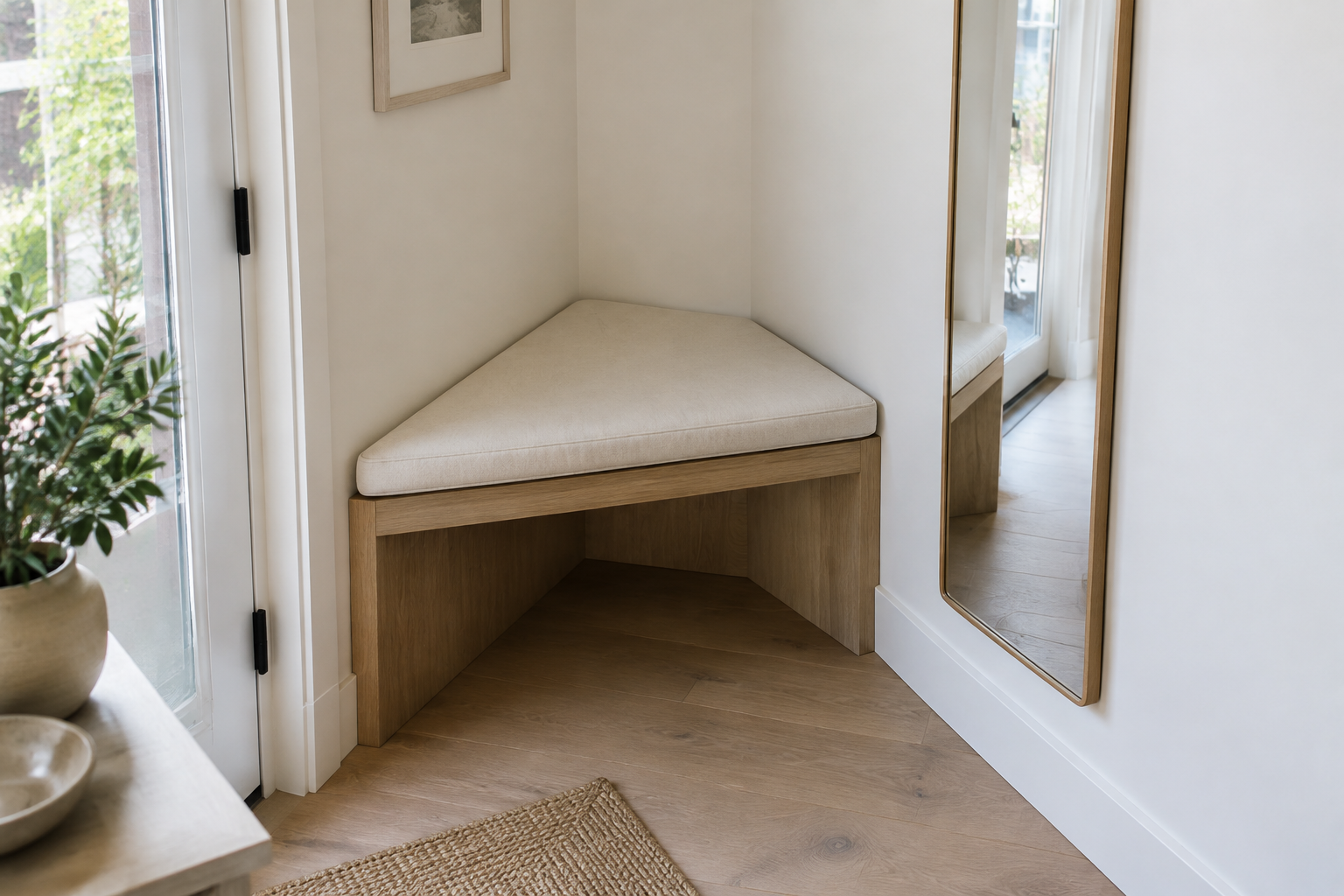
Idea 31
Corner triangle bench
A wedge-shaped seat slots into an unused ninety-degree corner. It turns wasted floor into a real perch.
Fit the cushion as a single wedge rather than three squares. The lines should follow the shape.
Hang a single tall mirror on the adjacent wall. Corners feel twice as wide when they reflect.
Wedge shaped corner bench with a single triangular cushion in a small entryway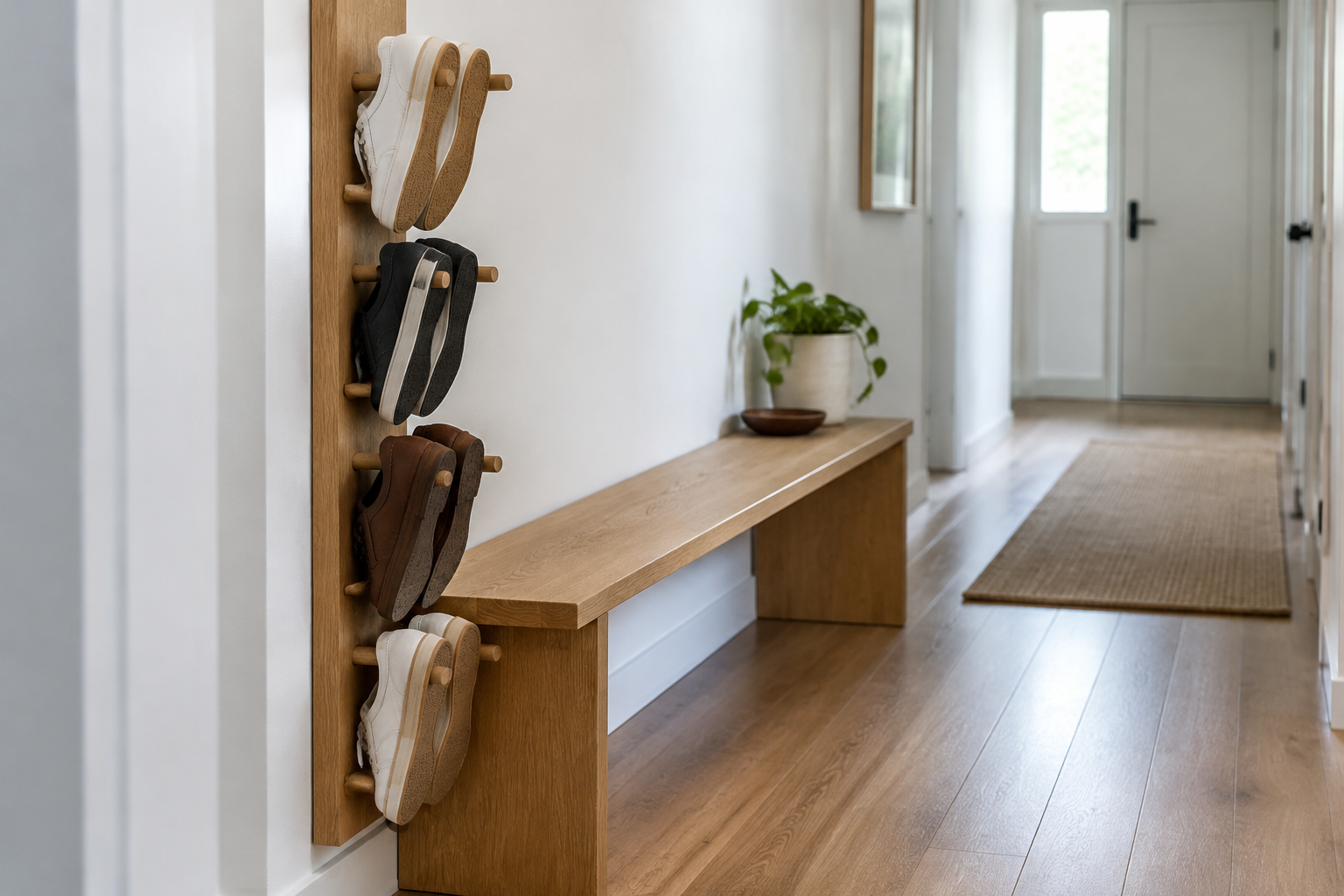
Idea 32
Bench with a vertical shoe rail
A slim vertical rail of pegs at the bench end holds five or six pairs of shoes upright. It uses height where floor space does not exist.
Space the pegs by shoe width, not evenly. Function beats symmetry here.
Angle the rail slightly off the wall so wet soles drip clear of the skirting.
Slim bench with a vertical peg rail holding shoes upright at the endFarmhouse, vintage and coastal benches
Warm, worn and washable. These eight ideas suit houses that would rather look lived-in than styled.
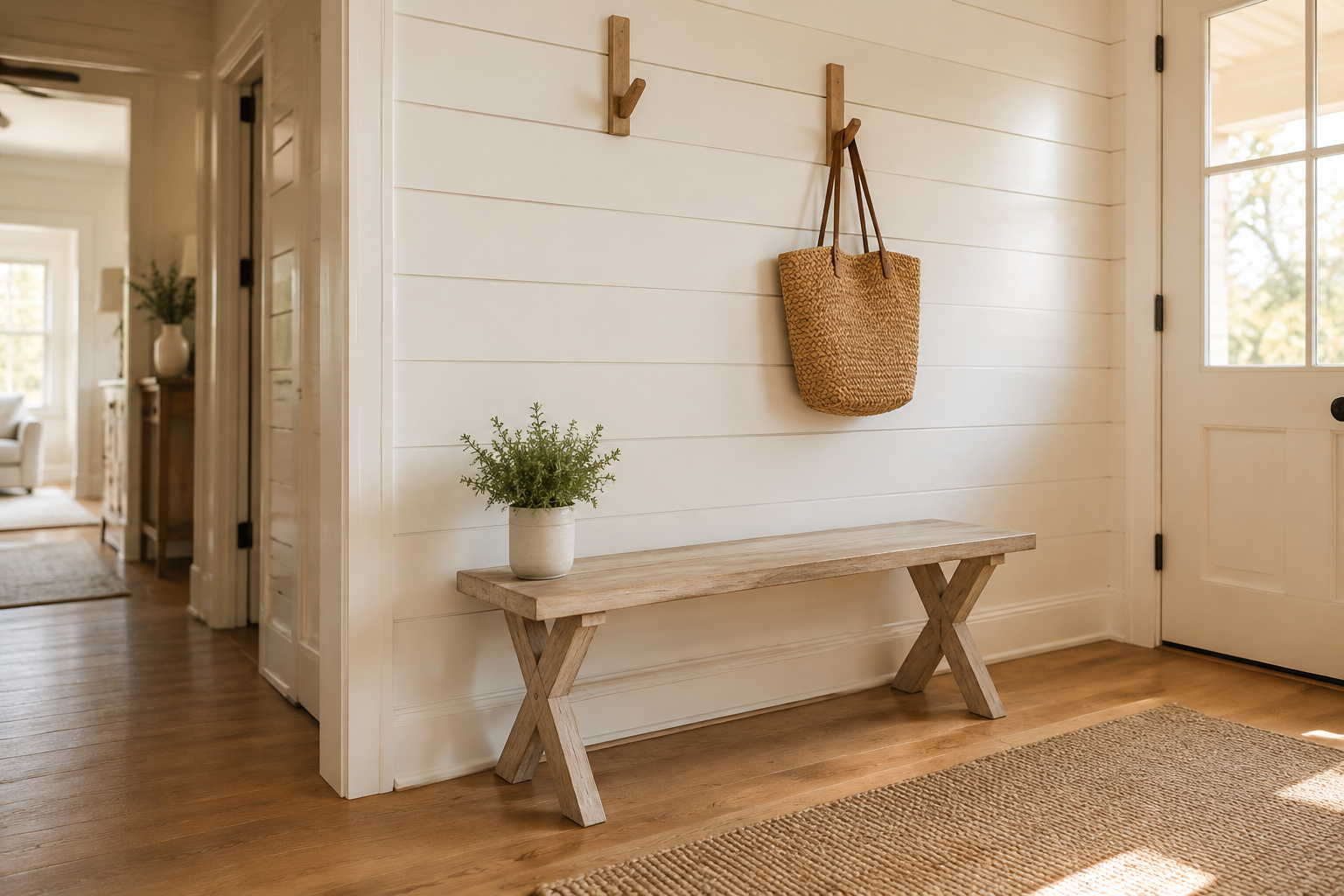
Idea 33
Shiplap nook with X-legs
Horizontal shiplap behind a simple X-leg bench is the classic farmhouse recipe. The horizontal lines widen a narrow entry.
Keep the shiplap the same colour as the walls. Contrast turns it into a busy backdrop.
Add a pair of hooks on the shiplap, not above it. Hooks on the panel look intentional.
Horizontal shiplap wall behind a simple X leg farmhouse entryway bench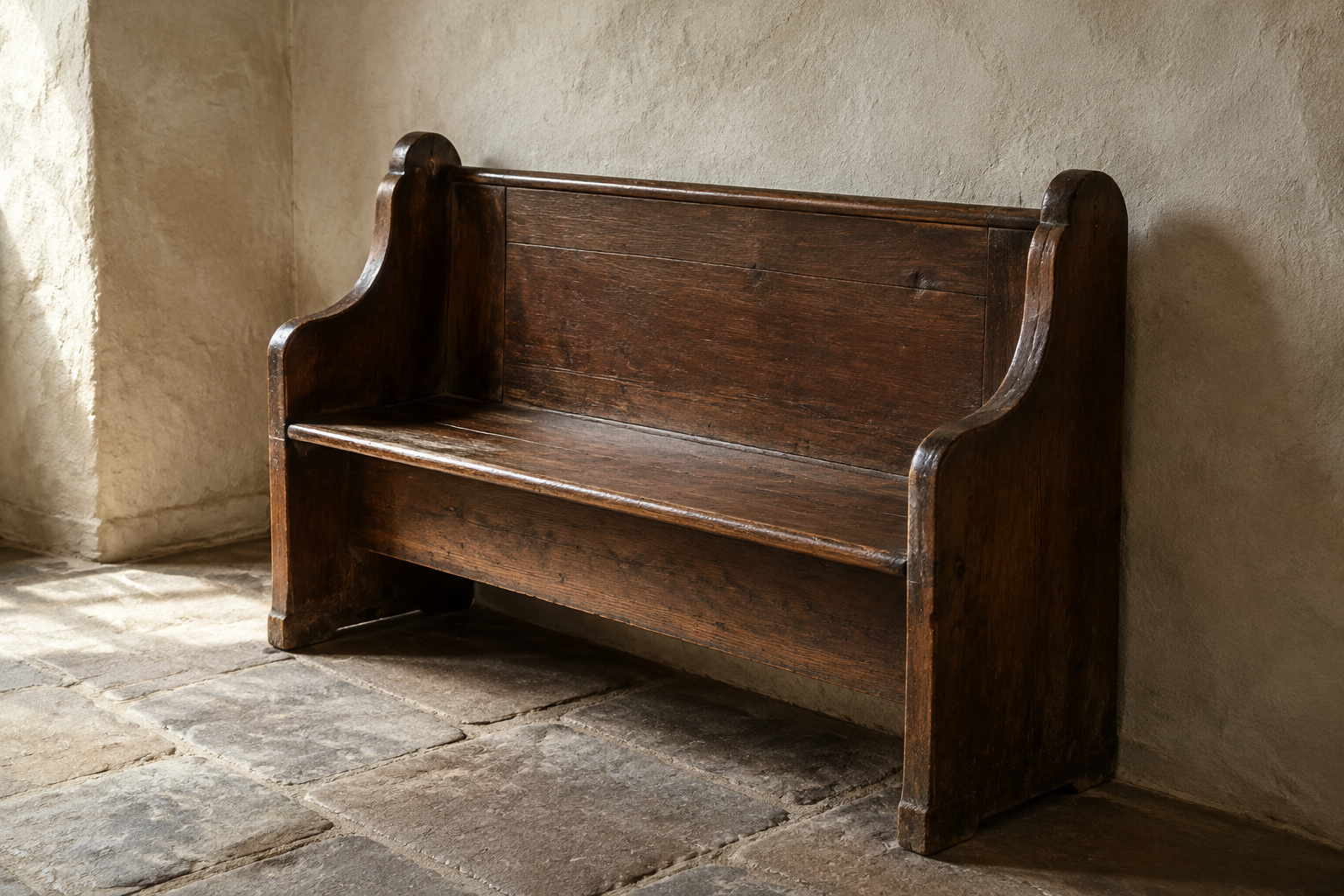
Idea 34
Antique church pew
A short church pew brings real age, real wood and a story into the entry. Wax it and leave the wear exactly as it is.
Check the depth before you buy. Pews are usually 45cm deep, which is tighter than a standard bench.
Keep the pew alone on its wall. Anything next to it looks like an afterthought.
Antique wooden church pew used as an entryway bench with original worn finish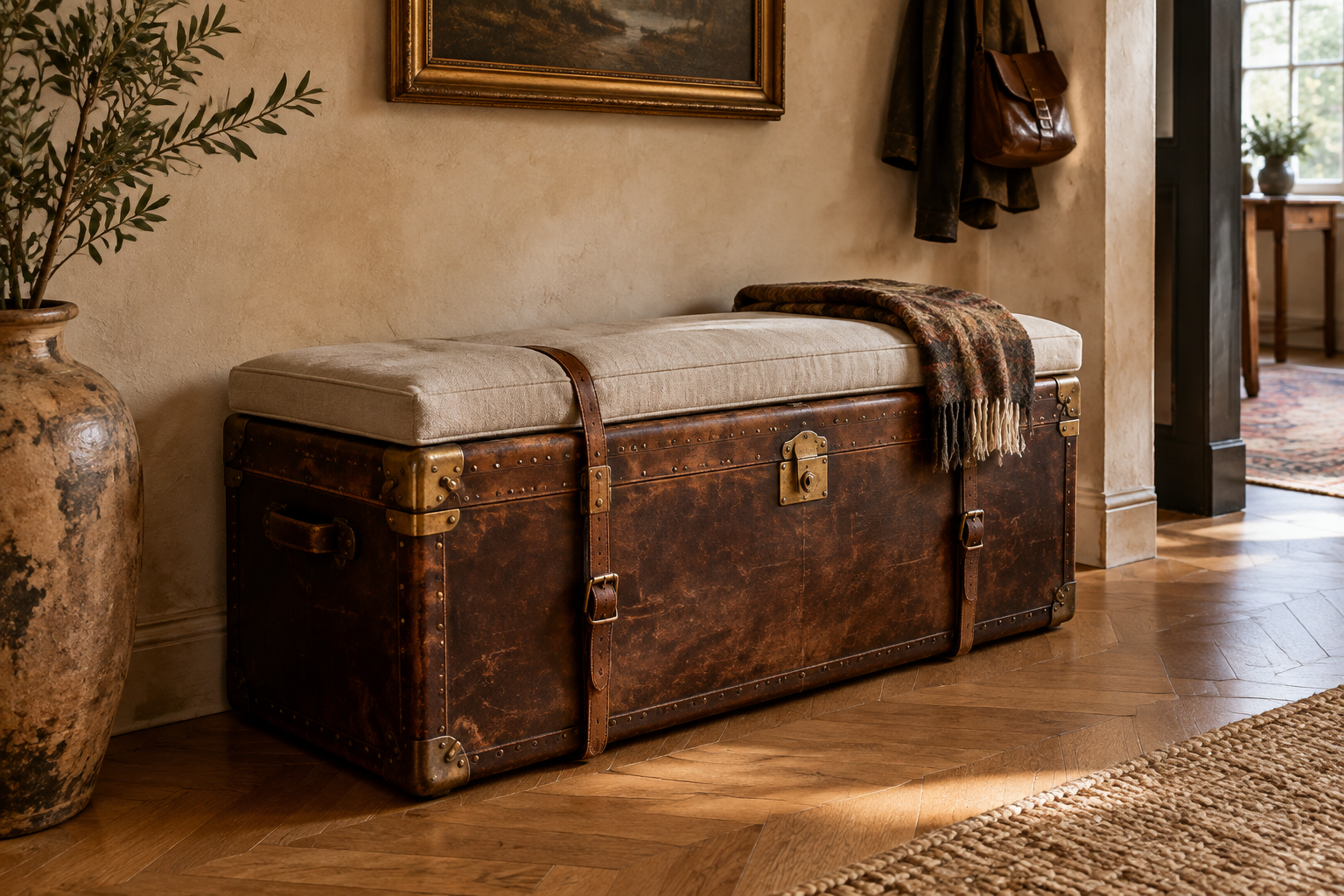
Idea 35
Vintage trunk bench
A leather-bound steamer trunk works as a bench, a table and a hiding place. Nothing needs building at all.
Add a flat cushion, because trunks are hard and guests will sit on them anyway.
Check the lid hinges before using it daily. Old straps look wonderful and fail suddenly.
Leather bound vintage steamer trunk used as an entryway bench with a flat cushion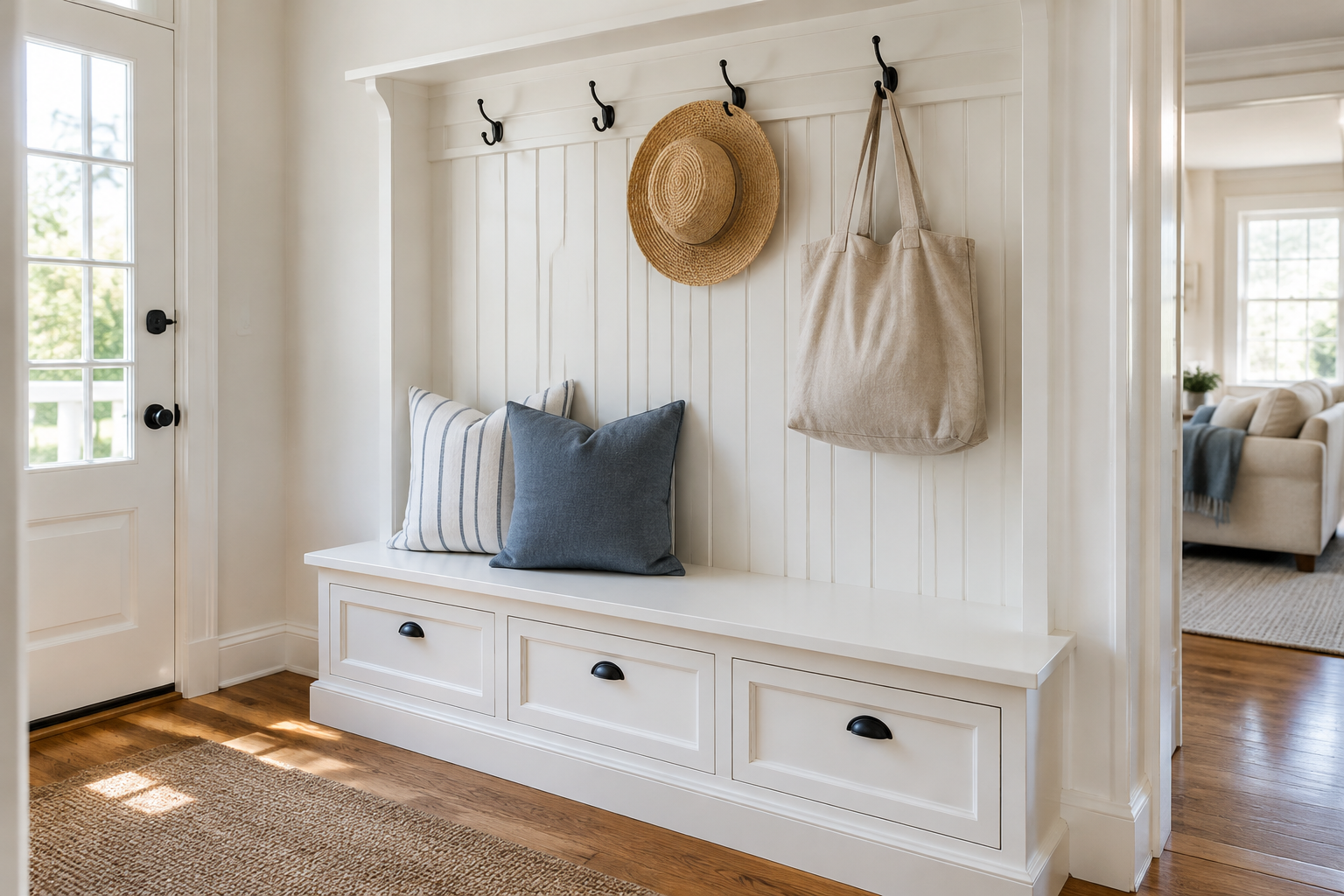
Idea 36
White beadboard farmhouse bench
Beadboard panelling and a white painted bench create a bright, washable surface for a busy family hall. The vertical grooves hide scuffs well.
Use satin rather than gloss paint. Gloss shows every fingerprint at exactly eye level.
Choose a warm white, not a blue white. Hallways rarely get enough light to carry a cool tone.
White painted farmhouse entryway bench with vertical beadboard panelling behind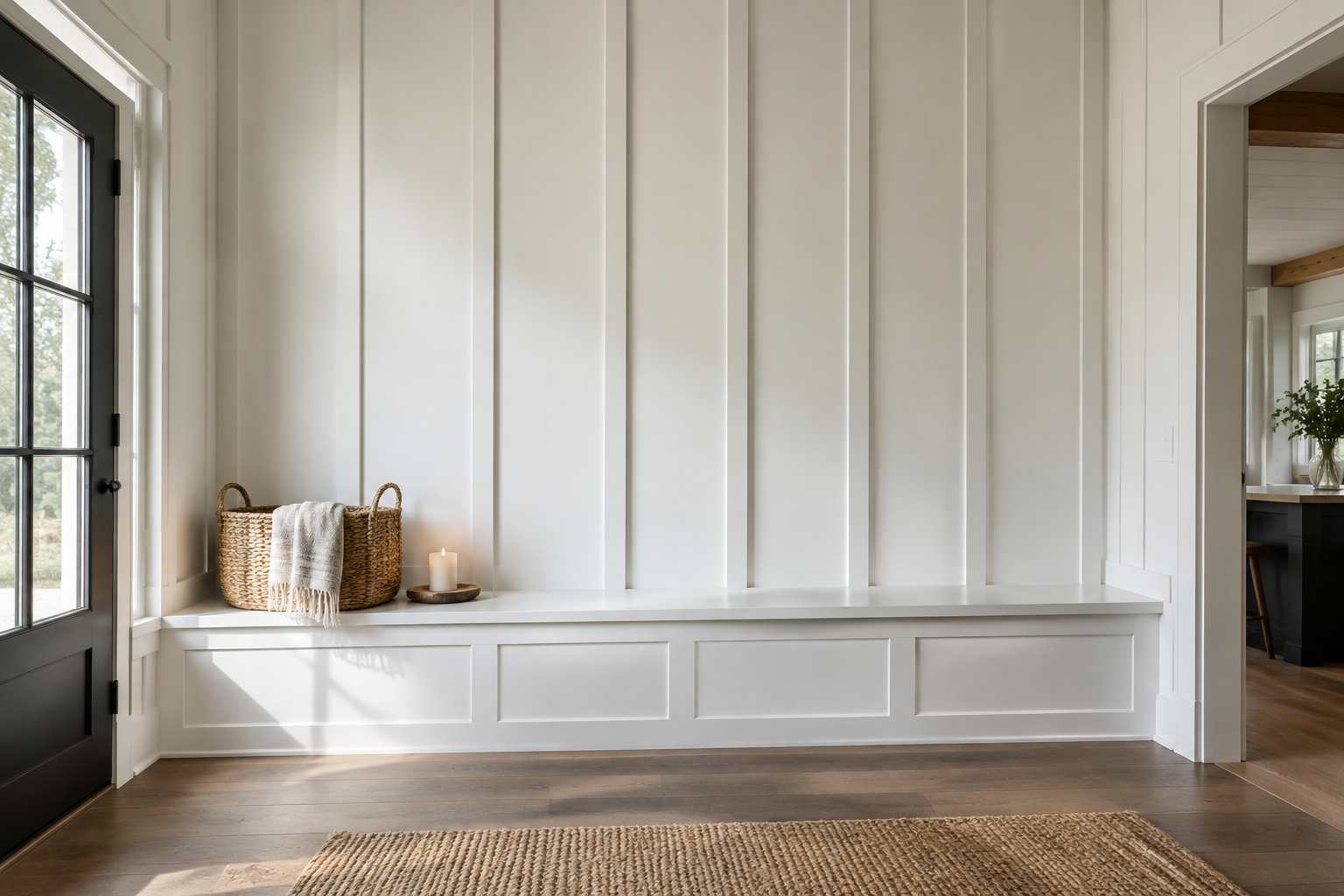
Idea 37
Board-and-batten bench wall
Board-and-batten panelling behind a bench adds height and structure. The vertical battens draw the eye upward.
Run the bench the full width of the panelling. A bench that stops short looks unfinished.
Paint the battens and wall the same colour. Two tones will fight every coat you hang.
Board and batten panelled entryway wall with a bench running the full width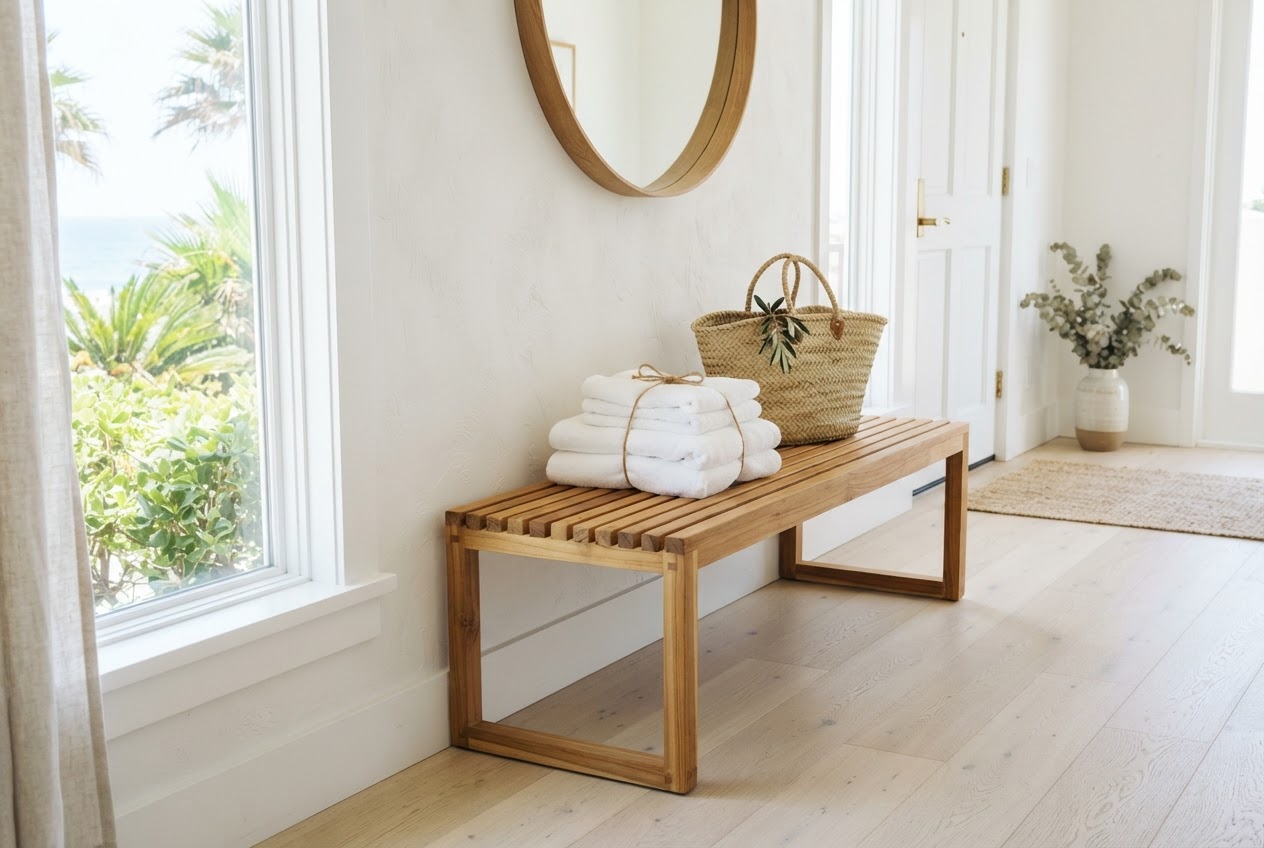
Idea 38
Coastal teak slat bench
Slatted teak with a low, spa-like profile suits light-flooded entryways. The open slats let wet coats breathe and dry fast.
Oil teak indoors even though it can be left bare outside. Indoor air is too dry to stop it fading.
Keep the slat gaps under 10cm so nothing small falls through.
Slatted teak entryway bench with a spa like open profile in a light filled hall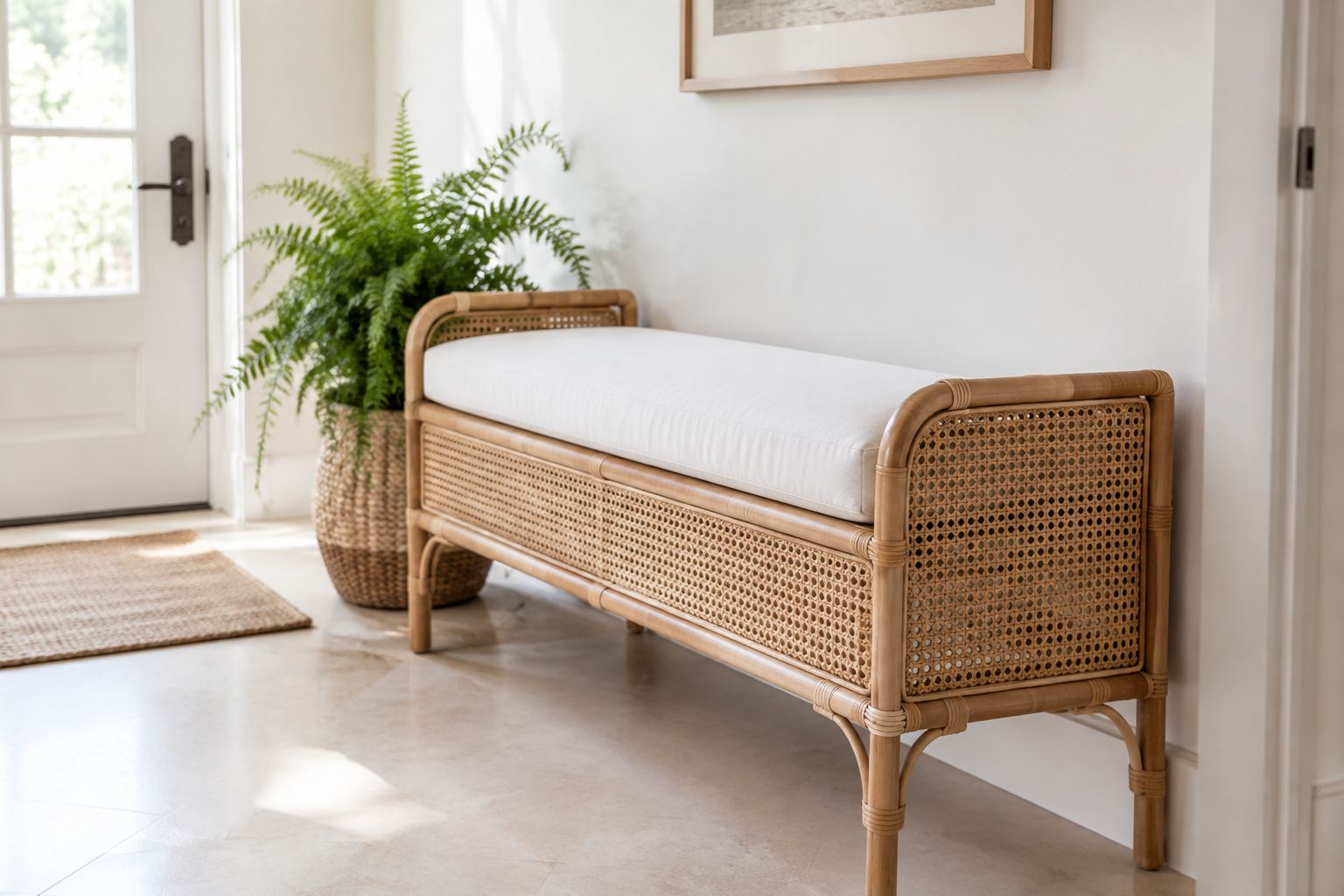
Idea 39
Wicker and rattan bench
A rattan frame with a thick cushion adds warmth and texture instantly. It works particularly well in a small, pale hallway.
Choose a natural finish over whitewashed rattan. The natural tone holds up better over time.
Keep the cushion plain and light. Rattan already supplies all the pattern the room needs.
Natural rattan framed entryway bench with a thick white cushion in a pale hallway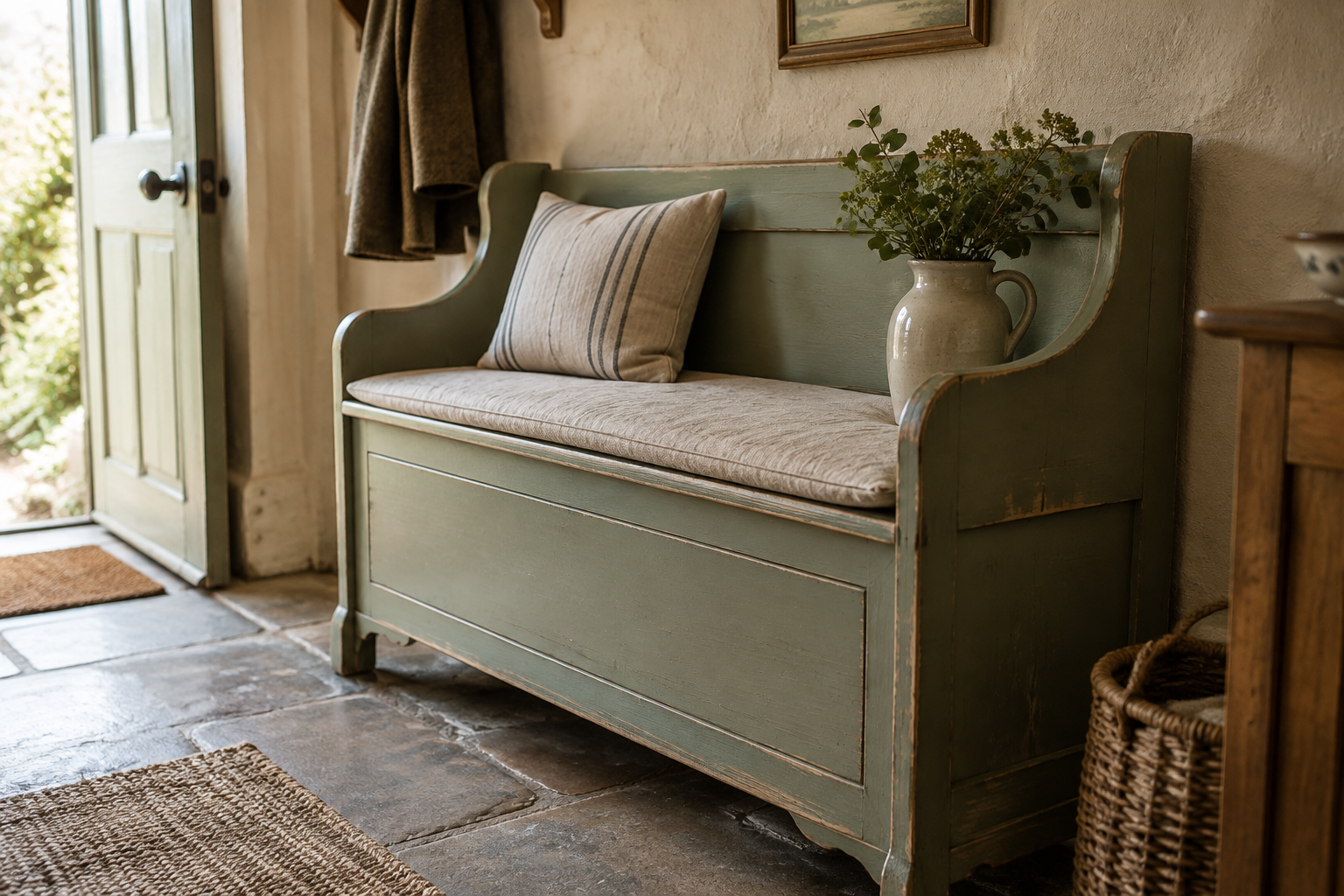
Idea 40
Chalk-painted bench with distressed edges
Chalk paint needs no primer and sands back beautifully on the edges. Light wear on the corners is the whole point.
Finish with clear wax rather than polyurethane. Wax keeps the matte, hand-finished look.
Distress only where hands and shoes actually touch. Random sanding reads as damage.
Chalk painted entryway bench with sanded distressed edges and matte wax finishModern, luxury and statement benches
For entryways that are meant to be looked at. These eight ideas use solid stone, bold colour and integrated light.
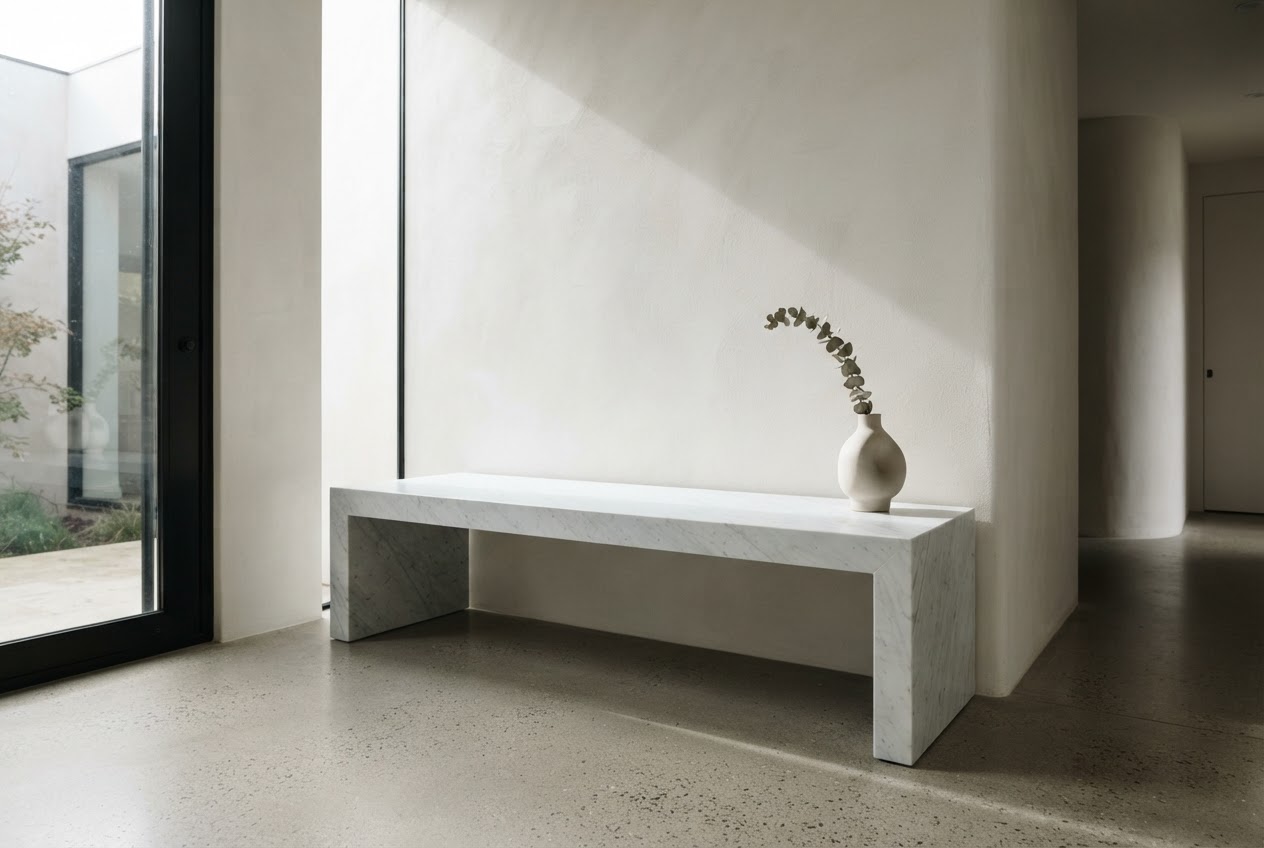
Idea 41
Waterfall marble bench
A marble slab that folds down both ends into solid sides looks sculptural and permanent. There are no legs and no visible fixings.
Seal the marble before first use. Entryway grit etches polished stone faster than anything else in a house.
Choose honed over polished. Honed marble hides the daily scuffs from bags and shoes.
Solid marble waterfall entryway bench with slab sides folding to the floor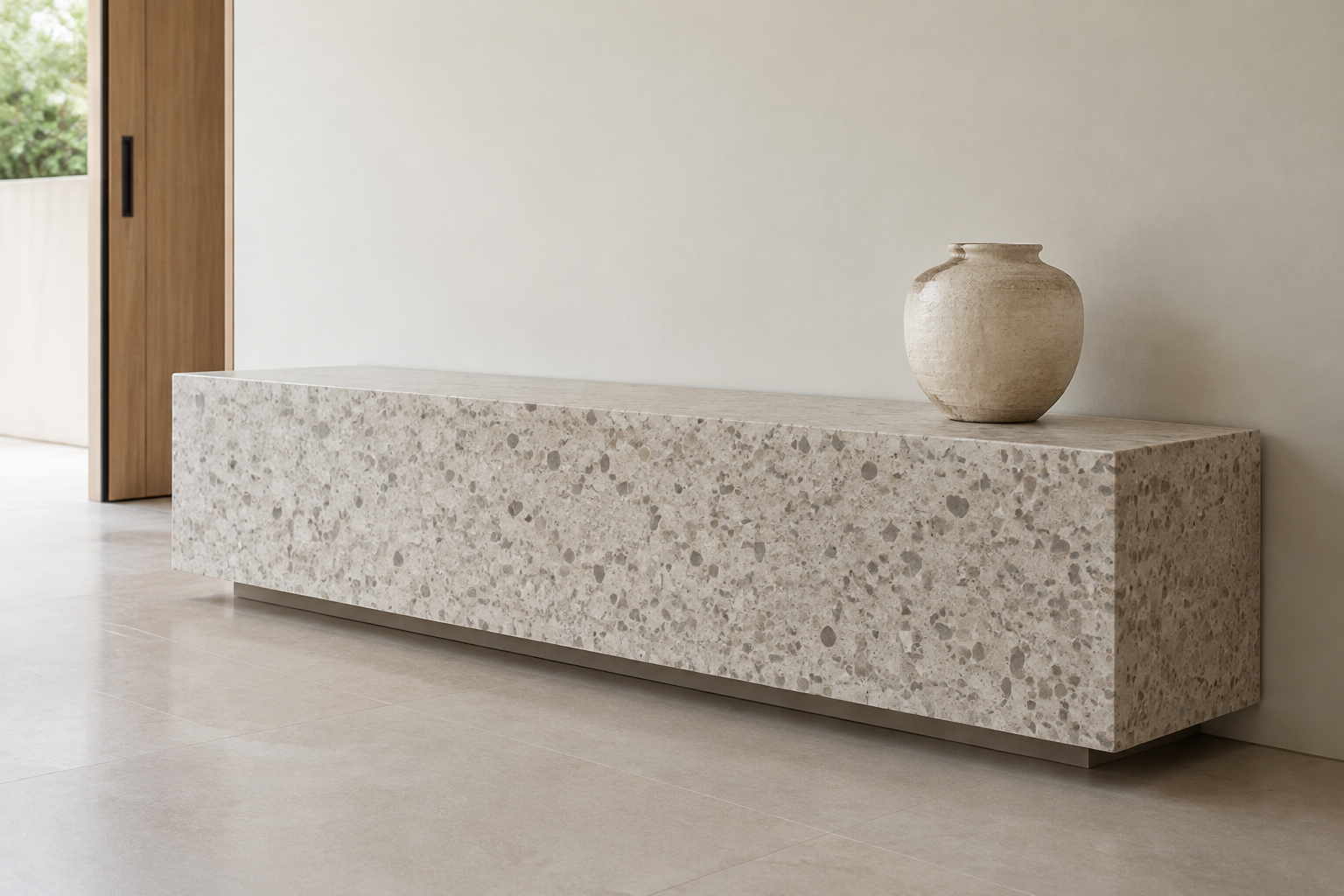
Idea 42
Terrazzo plinth bench
A solid terrazzo block with a wide speckle gives colour and weight in one move. It reads as a plinth with a bench built into it.
Keep the speckle small and tonal. Large multicolour chips date quickly.
Leave 10cm of shadow gap at the base so the block appears to hover slightly.
Chunky solid terrazzo plinth style bench with fine tonal speckle in an entryway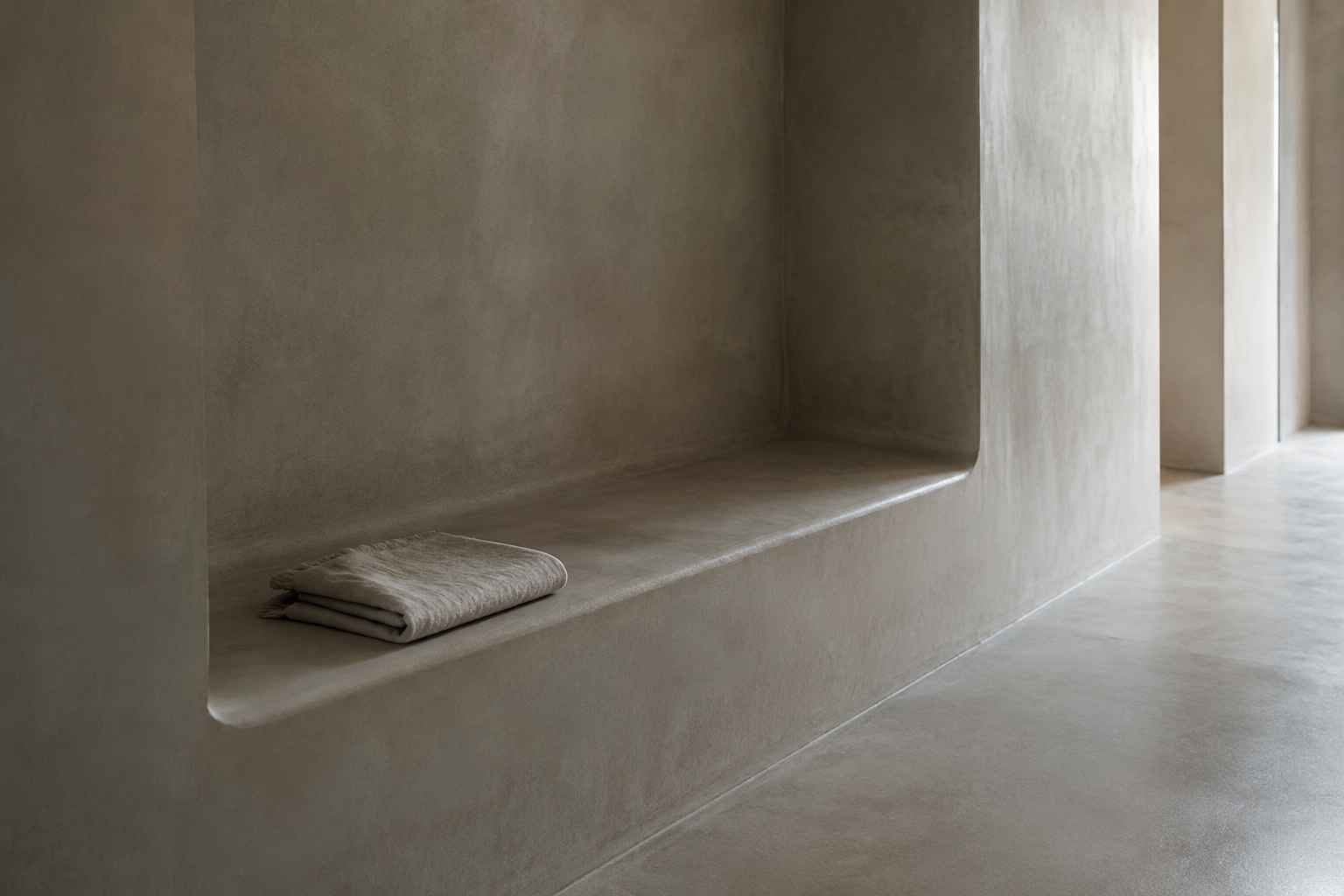
Idea 43
Micro-cement bench niche
A bench cast in micro-cement becomes part of the wall rather than an object in the room. The seamless finish suits minimalist homes.
Round every internal corner. Micro-cement is unforgiving on sharp edges.
Seal it twice and re-seal annually. The material is beautiful and slightly porous.
Seamless micro cement bench cast into a wall niche in a minimalist entryway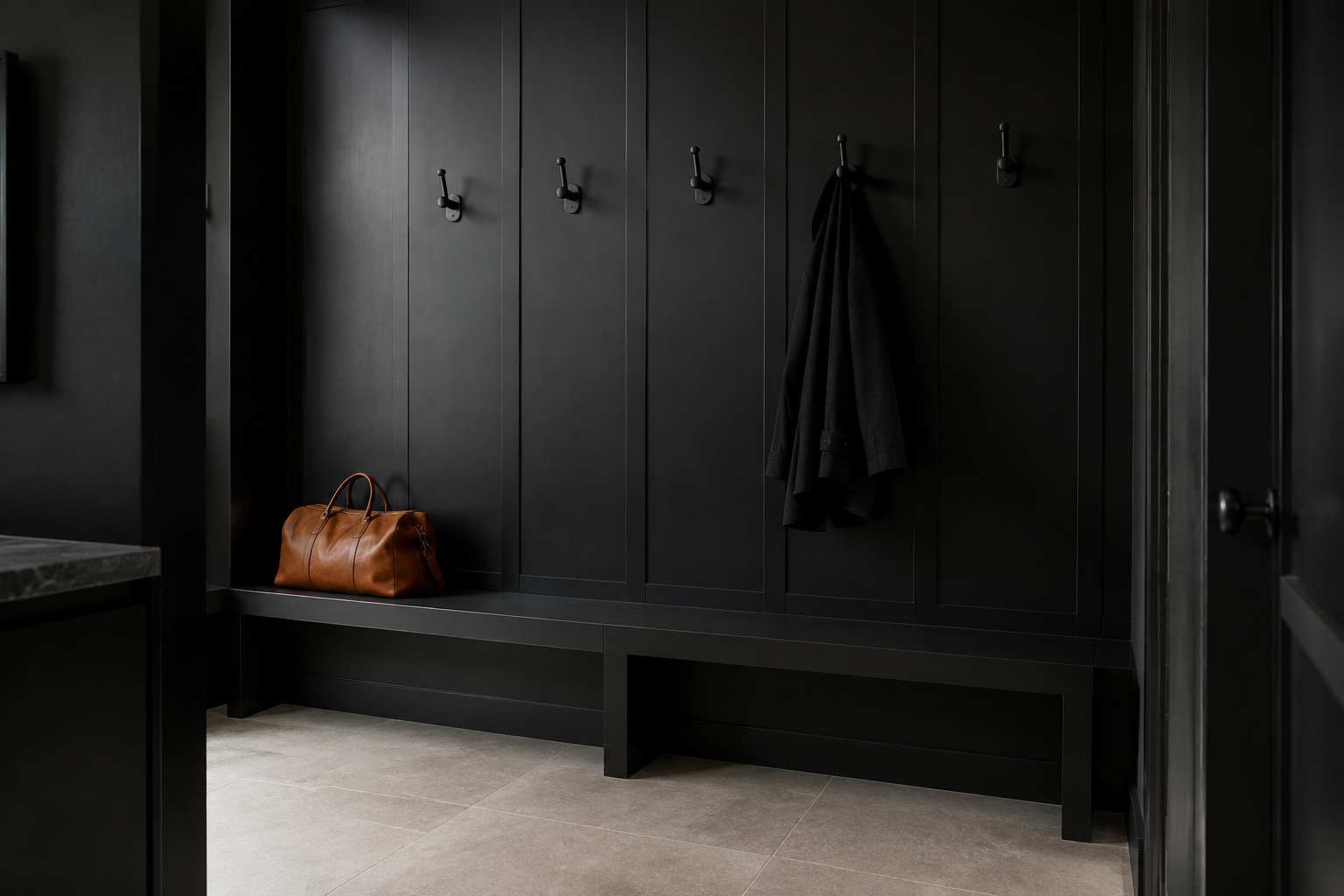
Idea 44
Monochrome black bench wall
An all-black bench, panelling and hooks create one bold graphic block. It anchors a pale hallway with real confidence.
Use matte black throughout, because mixing sheens breaks the effect completely.
Add one warm material, such as a leather bag or a brass tray. Black needs a single note of warmth.
All black entryway bench wall with black panelling hooks and matte black bench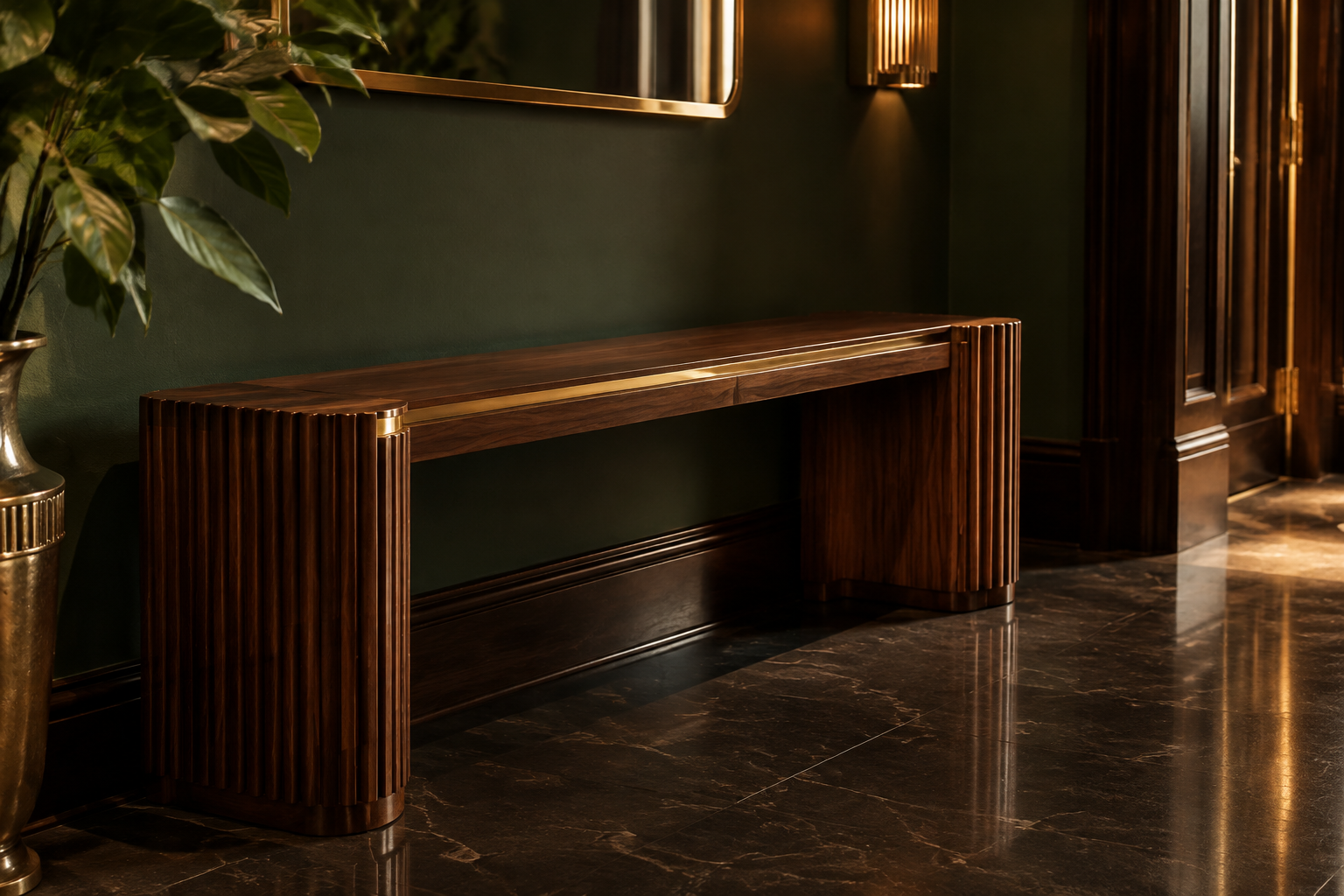
Idea 45
Art Deco bench with brass inlay
Fluted sides and a thin brass line along the seat edge give a nineteen-thirties feel. Walnut keeps it warm rather than theatrical.
Inlay the brass flush rather than proud. Anything raised will catch clothing every time.
Keep the cushion absent. This bench is geometry, and upholstery softens the geometry.
Walnut art deco entryway bench with fluted sides and a thin brass inlay along the seat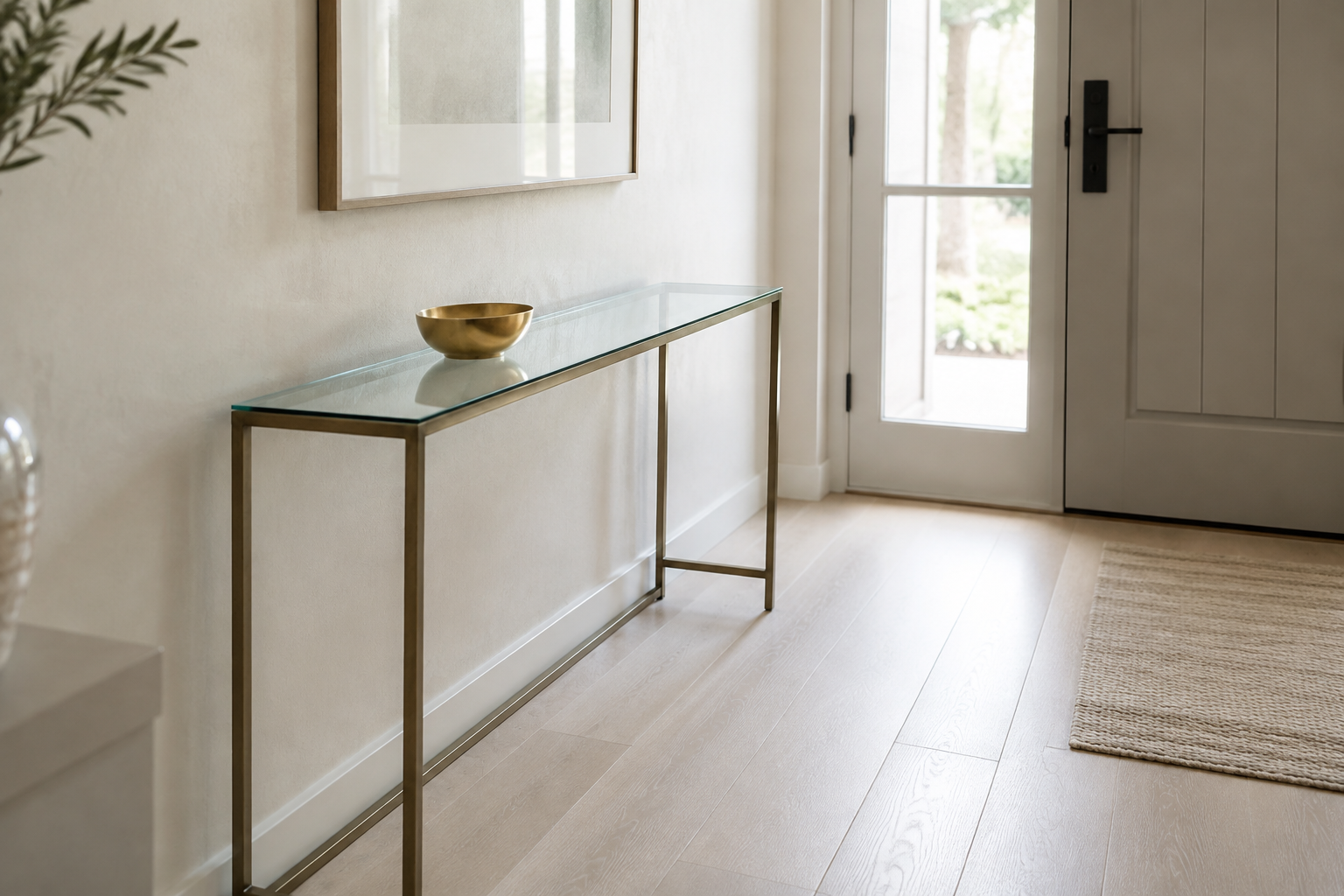
Idea 46
Glass and bronze console bench
A slim bronze frame with a glass top looks almost weightless. It suits hallways where a solid bench would crowd the door.
Use toughened glass at least 10mm thick. This is a bench, not a shelf.
Keep the frame narrow so your legs clear it when you sit down.
Slim bronze framed console bench with a thick glass top in a compact entryway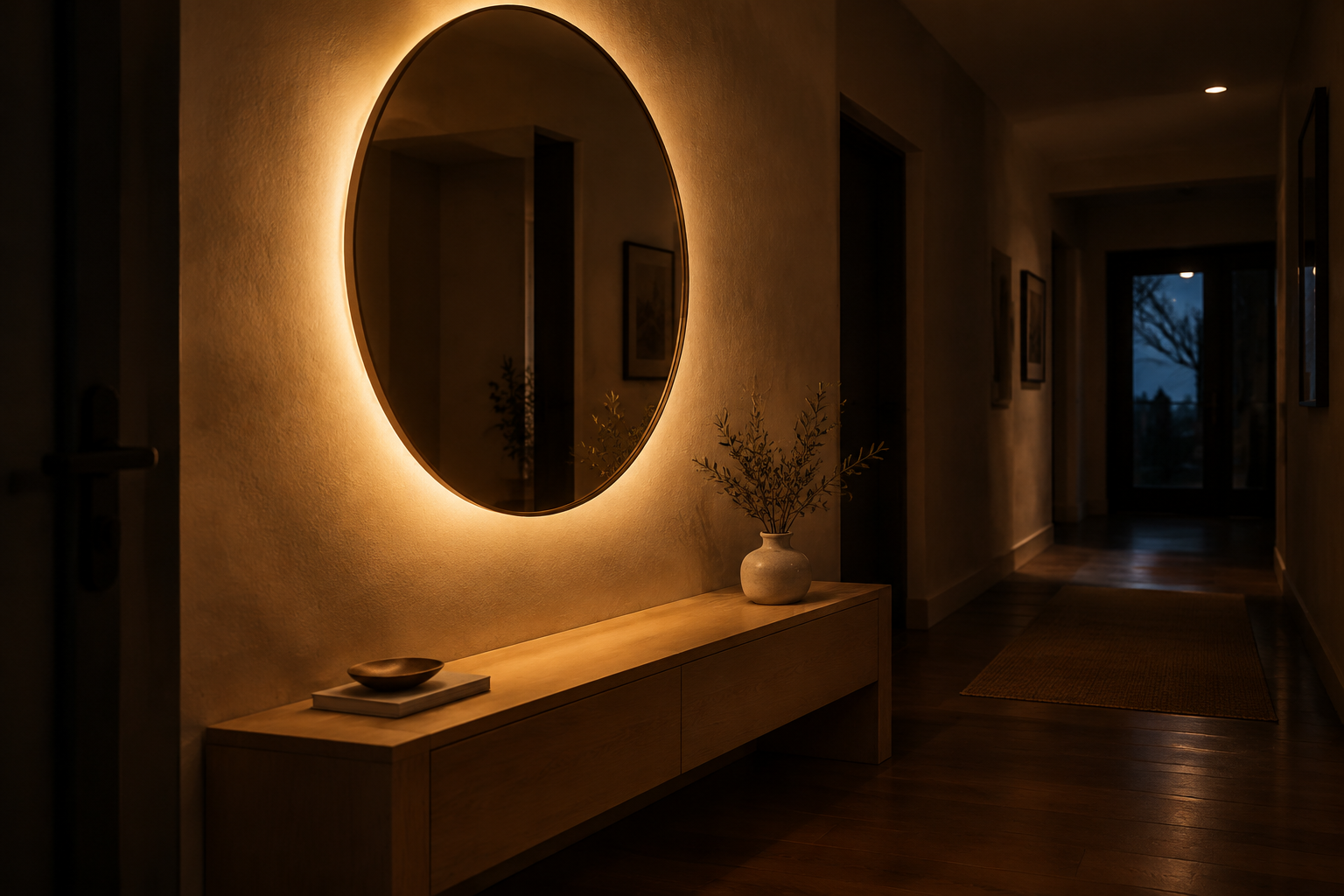
Idea 47
Backlit mirror bench wall
A large round backlit mirror above a low bench creates a soft glow at eye level. It makes a dark hallway feel twice its size.
Choose warm light around 3000K. Cool hallway lighting makes skin look grey in the reflection.
Hang the mirror 20cm above the bench back so the glow washes the wall, not the seat.
Large round backlit mirror above a low entryway bench with a soft warm glow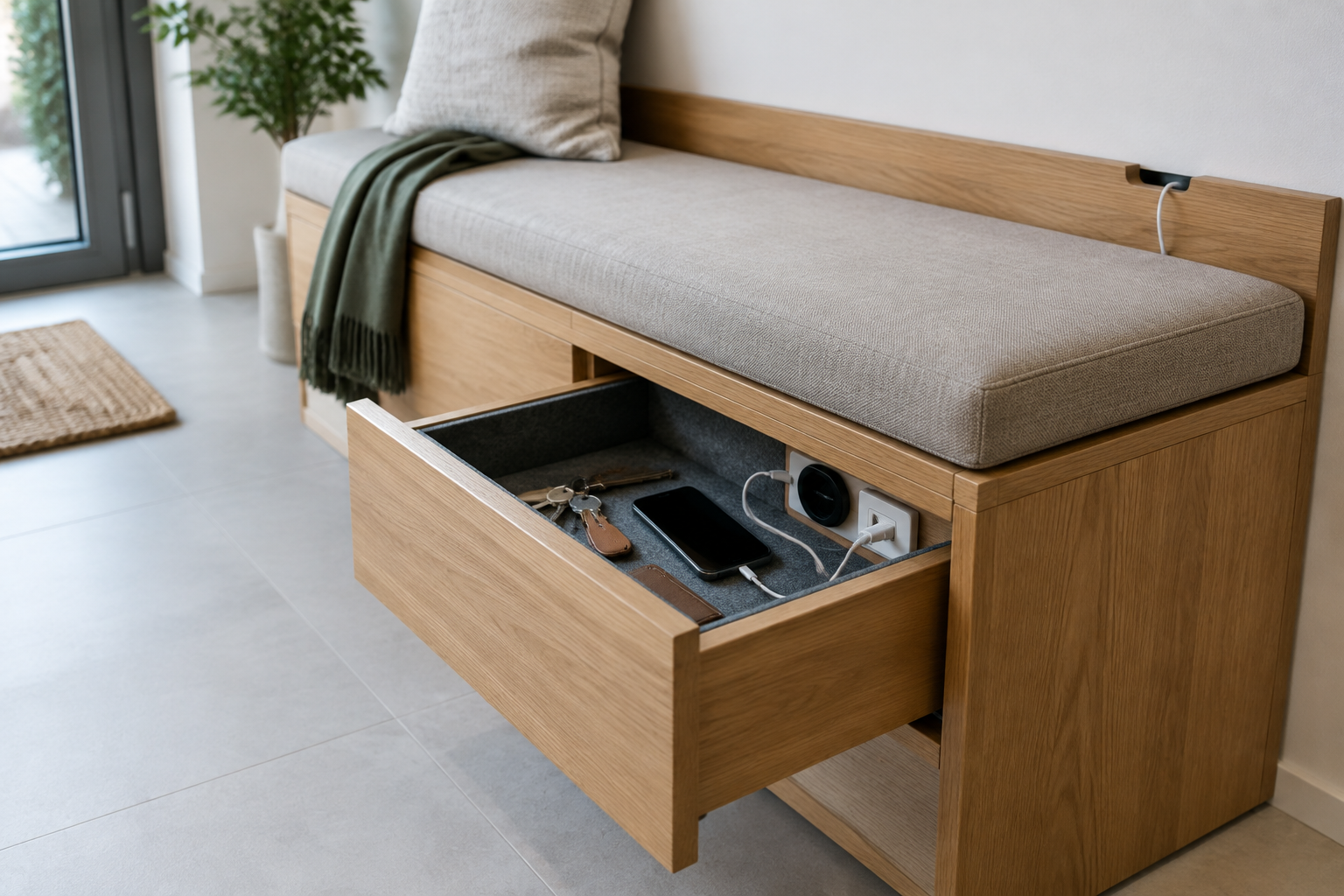
Idea 48
Smart drop-zone bench with charging
A bench with a concealed tray, two charging points and a cable slot keeps keys and phones tidy and topped up. It is the bench a modern family actually needs.
Put the socket inside the drawer rather than on the front. Visible cables undress the whole design.
Add a felt-lined tray so keys land quietly and do not scratch the timber.
Modern entryway bench with concealed charging drawer and cable slot for phones and keysFive rules that make any of these benches look finished
Rule one is height. A bench with nothing above it looks like it is waiting for something.
Hang a mirror, a hook rail or a picture ledge so the wall is resolved from floor to ceiling.
Rule two is one material repeat. Pick a single finish, brass or black or oak, and use it three times in the space.
Rule three is a landing tray. A tray catches keys, coins and receipts and stops them scattering across the seat.
Rule four is a single basket. One woven basket absorbs the visual mess of gloves, hats and shopping bags.
Rule five is light. Add a small lamp or a backlit mirror, because no entryway has ever had too much light.
FAQEntryway bench questions, answered
How wide should an entryway bench be?
Aim for 90cm to 150cm for a single person to sit comfortably. Anything under 75cm works as a perch but not as real seating.
What is the best height for an entryway bench?
The standard seat height is 45cm. Use 48cm for older users or anyone with knee trouble, because the extra height is easier to stand up from.
How deep should an entryway bench be?
35cm to 45cm is comfortable for sitting. In hallways under 110cm wide, drop to 25cm and mount the bench to the wall instead of using legs.
Is a storage bench worth it in a small hallway?
Yes, if you buy drawers or tilt-outs rather than a lid. A lid needs clear space above it, which small hallways rarely have.
What wood is best for an entryway bench?
White oak and ash take knocks and hide scratches best. Pine is cheaper but dents quickly in a high-traffic hallway.
How high should hooks go above a bench?
Leave 150cm of clear height above the seat for long coats. Shorter hooks will let coat hems sit on the bench and get sat on.
Can I put a bench in front of a radiator?
Only with a slatted cover and at least 5cm of clearance around the radiator. A sealed box will cut your heat output noticeably.
How do I stop a bench looking cluttered?
Give every item a container. One tray, one basket and one hook per person covers almost everything a hallway collects.
Pick one idea and commit to it
The best entryway bench is not the most beautiful one on this list. It is the one that fits your hallway and your actual life.
Measure the depth first, then the wall, then count the shoes. Everything else is style, and style is the easy part.
Choose one idea from these 48, build it properly, and stop adding to it. Restraint is what makes an entryway feel calm.


